Forged Steel vs. Cast Iron Bench Vises: Why Cheap Vises Snap in Half (And What to Buy)

Cheap hardware store vises crack like peanut brittle under heavy hammer blows. Here is why ductile iron and forged steel beat brittle grey cast iron on every workshop bench.
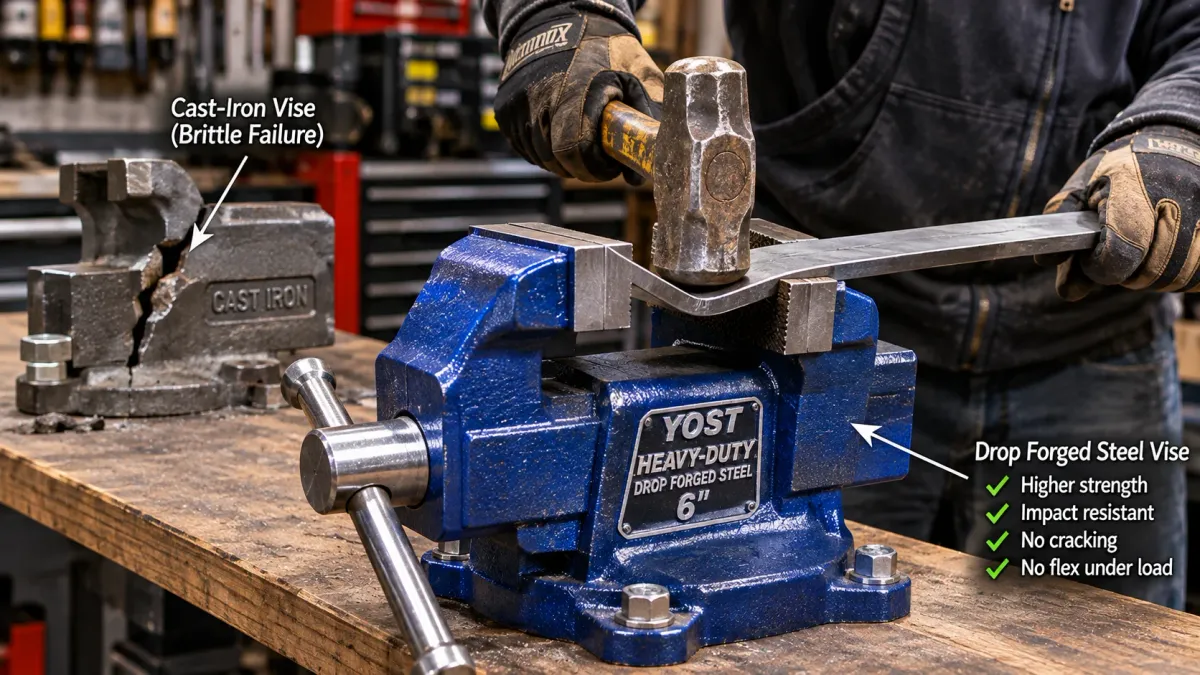
Table of Contents4 Sections
You clamp a thick piece of flat steel bar into your brand-new $60 hardware store vise. You grab a 3-pound drilling hammer, take aim, and strike the steel to bend a ninety-degree mounting bracket.
On the third blow, a sharp crack echoes through the shop. The dynamic front jaw snaps completely off the slide bar, tumbling down to the concrete slab and narrowly missing your work boots. When you look at the raw fracture point, the metal inside looks dull, dark grey, and granular, almost like compressed sandbox grit.
You did not break that vise through sheer strength. You fell victim to cheap metallurgy.
In home garages across America, workbenches hold hundreds of thousands of low-grade grey iron vises that cannot handle basic fabrication work. If you plan to bend metal, drive out rusted suspension pins, or strike steel parts on an anvil horn, you need to understand the mechanical boundary between brittle grey iron, tough ductile iron, and forged steel.
Metallurgy 101: Grey Iron vs. Ductile Iron vs. Forged Steel
When manufacturers stamp the words “Heavy-Duty Cast Iron” on a retail tool box, they usually describe cheap Class 20 or Class 30 Grey Cast Iron. The term “cast iron” simply means iron melted down and poured into a sand mold, but the microstructure inside that metal dictates whether your vise bends slightly or shatters catastrophically.
1. Grey Cast Iron (20,000 to 30,000 PSI Tensile Strength)
Grey cast iron cools slowly in the mold, allowing carbon to precipitate out in thin, jagged graphite flakes. Under a microscope, these microscopic flakes look like tiny razor blades embedded throughout the iron matrix.
Grey iron handles static compression well, which is why machine tool beds and engine blocks use it. However, it exhibits zero ductility and abysmal tensile strength. The sharp graphite flakes act as built-in crack starters. The moment you strike a workpiece with a hand hammer or slip a steel pipe over the handle for extra leverage, the iron fractures instantly without warning.
2. Ductile / Nodular Iron (60,000 to 65,000 PSI Tensile Strength)
To produce ductile iron, foundry workers add a small amount of magnesium into the molten iron ladle just before pouring. This magnesium treatment alters the carbon crystallization, forcing graphite to form smooth microscopic spheres or nodules instead of sharp flakes.
These spherical carbon nodules eliminate stress-concentration lines inside the metal. Under the ASTM A536 standard specification for ductile iron castings, nodular spheroidal graphite structures provide superior elongation and shock absorption, delivering more than double the tensile strength of grey iron. It flexes microscopically under heavy impact, absorbing hammer blows and heavy torque without snapping. For 95 percent of home workshops, ductile iron represents the ideal balance of affordability and commercial-grade strength.
3. Drop Forged Steel (75,000+ PSI Tensile Strength)
Forging eliminates casting molds entirely. A solid billet of medium-carbon steel gets heated until glowing yellow, placed between massive matching dies, and hammered under thousands of tons of hydraulic force.
This mechanical compression aligns the internal grain structure of the steel along the contour of the tool body. Forged steel vises resist massive shock loads, severe vibration, and extreme bending forces. If you subject a forged steel vise to impossible loads, the steel distorts and yields rather than shattering into dangerous flying shrapnel.
Bench Vise Metallurgy Comparison
Class 20/30 Grey Cast Iron
60-45-18 Ductile Nodular Iron
Drop Forged Carbon Steel
4 Anatomy Features That Make a Great Garage Vise
Beyond raw metal chemistry, inspect these four mechanical details before bolting any vise to your bench:
- Throat Depth: Measure the distance from the top of the steel jaws down to the center slide beam. Cheap vises cut corners here, offering less than 2.5 inches of throat clearance. Look for at least 3.5 to 4 inches of throat depth so you can clamp long pipe fittings and tall angle brackets vertically without bottoming out.
- Integrated Pipe Jaws: Quality mechanics vises include cast-in serrated pipe jaws beneath the primary flat jaws. These curved V-teeth secure round stock, suspension tie rods, and drive axles without spinning while you wrench.
- Dual-Locking Swivel Base: Cheap vises feature a single locking T-handle on the base. Under heavy wrenching, that single clamp slips, causing the entire vise to pivot when you torque a fastener. Insist on dual locking handles located on opposite sides of the swivel collar to lock the base securely.
- Substantial Machined Anvil: A flat, thick striking pad behind the dynamic jaw lets you rivet sheet metal, flatten rusted cotter pins, and drift out roll pins without denting the vise housing.
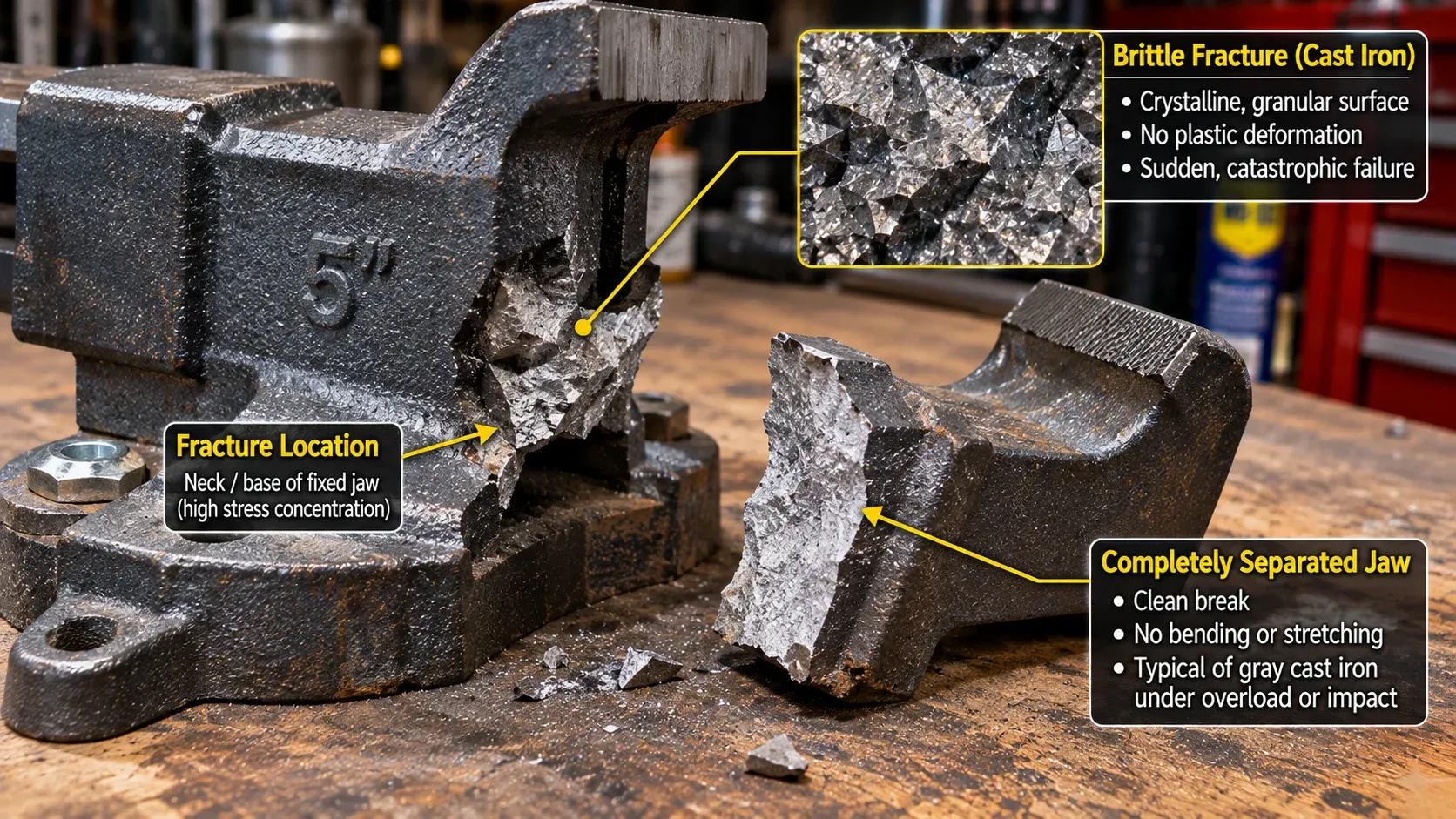
Detailed macro forensic engineering photo of a broken cast-iron bench vise jaw snapped completely off at the neck base, showing crystalline gray brittle fracture surface with zero plastic deformation, workshop lighting, technical evidence photo.
Tested Vises That Earn Their Bench Space
I have tested dozens of vises over decades of shop work. Here are three options that provide honest value, proven metallurgy, and long-term durability.
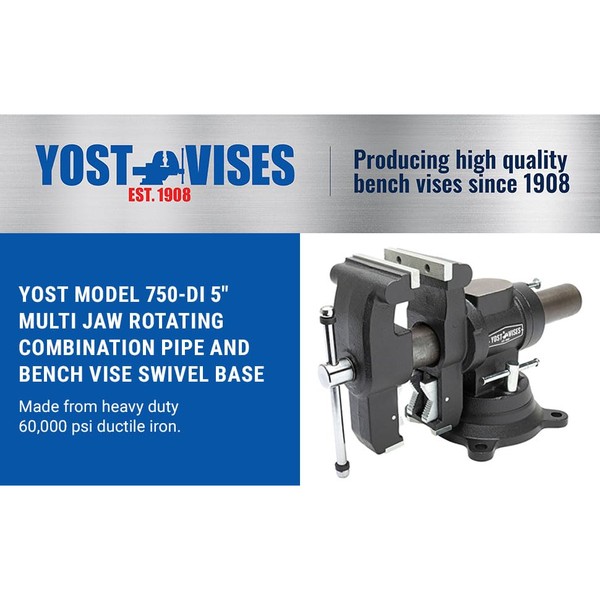
Yost Vises 750-DI 5-Inch Multi-Jaw Rotating Bench Vise
Best For: The ultimate do-it-all home garage vise that delivers commercial ductile strength under $200.
- +Cast from 65,000 PSI ductile iron for outstanding shock resistance
- +360-degree rotating head and dual-locking 360-degree swivel base
- +Deep 3.5-inch throat depth with integrated hardened steel pipe jaws
- +Generous 5-inch jaw opening handles bulky suspension parts with ease
- -Heavy 38-pound mass requires a robust bench top and through-bolts
- -Factory grease is heavy and needs cleaning before first operation
The Yost 750-DI is widely recognized as the sweet-spot vise for serious DIYers. Its 65,000 PSI ductile iron body tolerates hammer strikes that would crack two retail cast iron units. The rotating jaw head lets you index between straight machinist jaws and serrated pipe jaws in ten seconds.
Wilton 11106 6-Inch Heavy Duty Ductile Iron Vise
Best For: Fabricators and auto enthusiasts who want an indestructible classic fixed-jaw workhorse.
- +Massive 60,000 PSI ductile iron casting built for lifetime durability
- +Large precision-machined anvil strike plate for heavy metalforming
- +Enclosed main screw keeps metal chips, grinding dust, and grit off threads
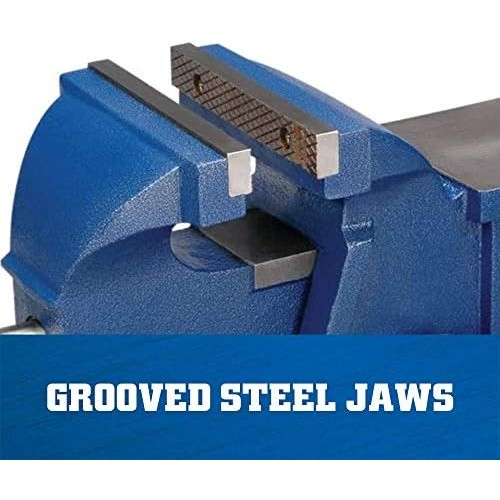
- +Wide 6-inch serrated jaw faces grip wide plate steel securely
- -Weighs nearly 45 pounds; needs dedicated corner bench reinforcement
- -Priced higher than entry-level import vises
If you prefer a traditional fixed-head bench vise without a rotating jaw mechanism, the Wilton 11106 delivers commercial-grade performance. The fully enclosed lead screw prevents hot metal shavings from fouling your drive threads when angle-grinding.
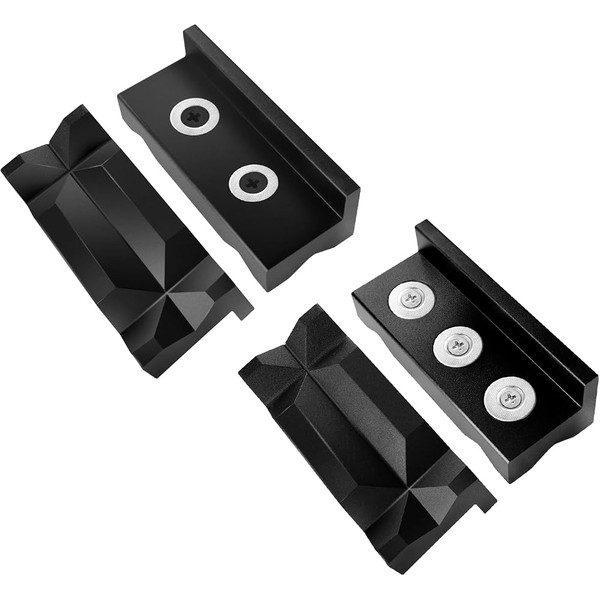
HORUSDY 4.5-Inch Magnetic Multi-Groove Soft Vise Jaws
Best For: Clamping threaded studs, brass plumbing fittings, or polished parts without marring surfaces.
- +Embedded neodymium magnets cling firmly to steel vise jaws
- +Thermoplastic polyurethane pads protect polished aluminum, chrome, and copper
- +Multi-angle 60-degree, 90-degree, and horizontal grooves hold round stock firmly
- -Pads melt if you clamp red-hot steel directly from a torch or welder
- -Requires occasional wiping to remove clinging ferrous metal shavings
A pair of magnetic soft jaws is mandatory. They snap over your serrated steel jaws instantly, allowing you to clamp delicate brass bushings, threaded shafts, or soft lumber without biting grooves into the surface.
Proper Bench Mounting: Don’t Rip Your Table Apart
A 65,000 PSI vise is useless if an aggressive pull rips the entire unit off your workbench. Never mount a vise using wood screws or lag bolts driven into plywood. The first time you use a breaker bar to loosen a frozen nut, the leverage will strip the lag threads right out of the wood grain.
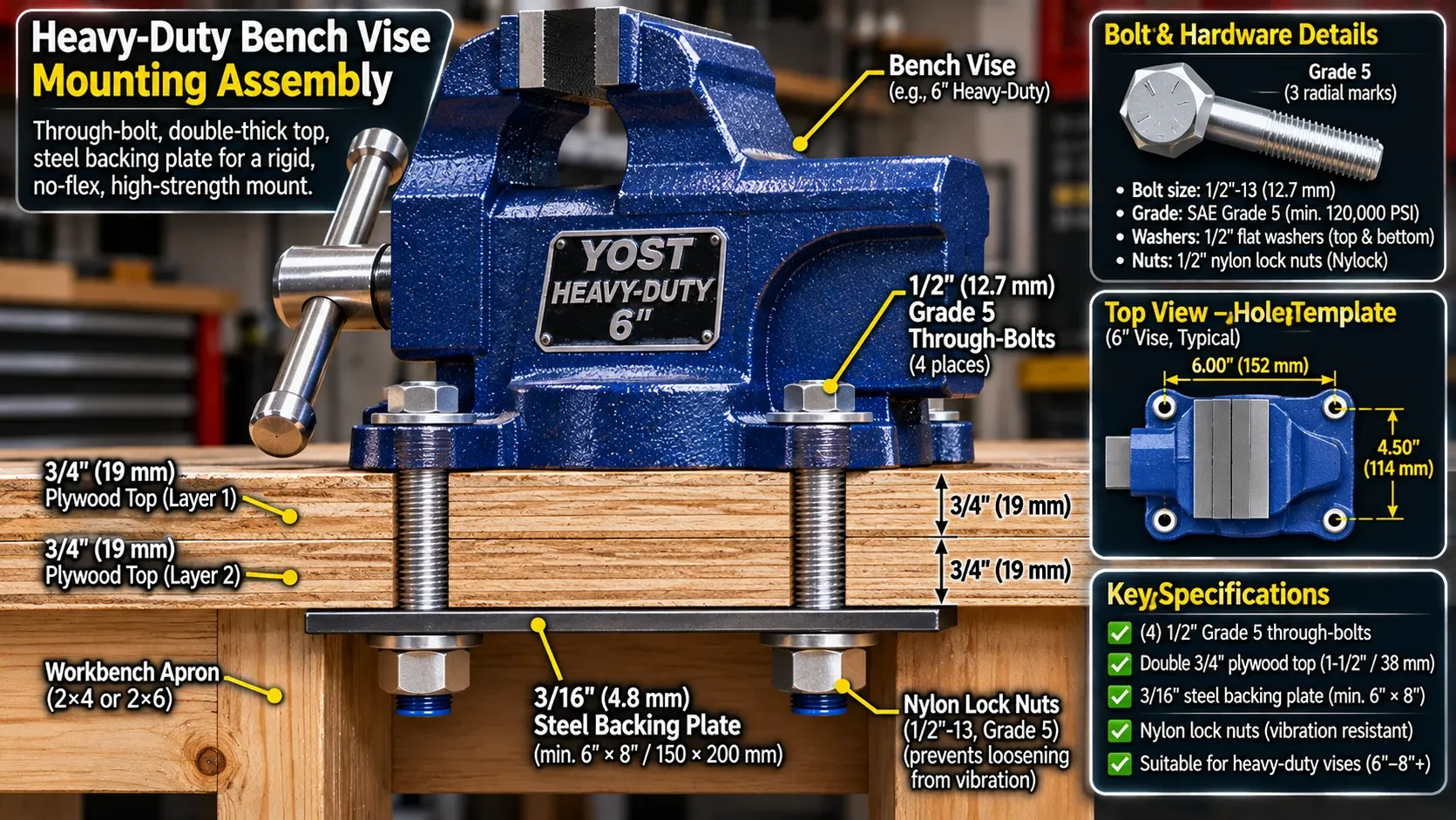
CAD engineering cross section diagram showing proper heavy-duty bench vise mounting assembly, showing 1/2-inch Grade 5 through-bolts penetrating double 3/4-inch plywood workbench top, backed by 3/16-inch steel backing plate beneath apron with nylon lock nuts, clear callout dimensions.
Follow these structural mounting guidelines:
- Position Over a Leg: Always mount your vise directly above a heavy front bench leg rather than in the middle of a wide table span. This transfers hammer blows down through the timber framing directly into the concrete floor.
- Drill Clean Through the Slab Top: Drill 1/2-inch clearance holes through your solid laminated top. If you haven’t built your workstation yet, follow our guide on building a wobble-free garage workbench.
- Install an Under-Bench Backing Plate: Cut a 6x6-inch piece of 1/4-inch steel plate (or use heavy 2-inch fender washers) against the underside of the bench top. The steel plate distributes upward pulling forces across a broad wooden footprint, preventing the bolt heads from sinking into soft wood fibers under heavy clamping pressure.
- Use Grade 5 or Grade 8 Hardware: Thread 1/2-inch Grade 5 plated bolts through the vise base, table top, and backing plate. Secure them with nylon-insert locknuts and torque them snug with a 3/4-inch socket.
Once you pair a ductile iron casting with a rigid, through-bolted bench station, you can clamp frozen tie rods, straighten bent control arms, and conquer difficult shop projects with total confidence. If you need to extract stubborn rusted fasteners clamped in your vise, pair it with our proven extraction methods in how to remove a stripped bolt, and assemble your table using our wobble-free garage workbench blueprint.
Hank Miller
Hank is a master craftsman and DIY mechanic based in Ohio. He tests workshop equipment, garage floor coatings, and power tools under brutal, real-world workshop conditions, with zero paid brand sponsorships.