What Size Air Compressor Do You Actually Need for a 1/2" Impact Wrench? (CFM vs. Tank Size Math)

Relying on big-box Max PSI numbers leaves impact wrenches sputtering on stubborn lug nuts. Learn the CFM flow math, tank reserve requirements, and high-flow coupler tricks.
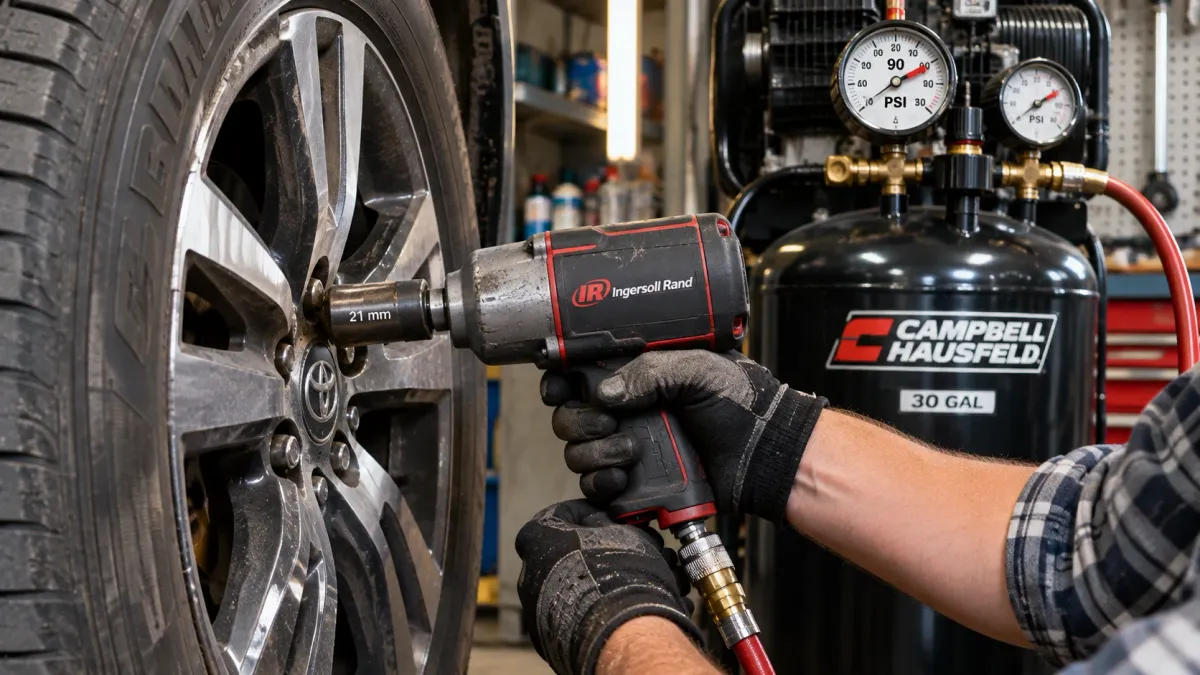
Table of Contents5 Sections
You buy a shiny new half-inch pneumatic impact wrench, connect it to the six-gallon pancake compressor sitting in your closet, slip a deep socket over a rusted wheel lug nut, and squeeze the trigger. The tool rattles weakly for two seconds, slows to a pathetic whine, and stalls completely while the compressor pump screams at ninety decibels for three minutes to rebuild tank pressure.
Homeowners assume their brand-new air gun is defective or that their lug nuts were torqued to four hundred foot-pounds by an overzealous tire shop technician. The real breakdown is simple fluid dynamics: you fed a high-consumption rotary air motor with a nail-gun compressor that cannot deliver continuous air volume.
I ran pneumatic service trucks and maintained fleet shops across Ohio for two decades. In this guide, I expose why retail marketing numbers like Max PSI are practically useless, walk through the actual CFM consumption math of half-inch impact guns, and explain how a fifteen-dollar fitting swap unlocks seventy percent more breaking torque.
The Big-Box Marketing Trap: Why “Max PSI” Is a Meaningless Lie
The Compressed Air and Gas Institute (CAGI) compressor verification standards measure actual continuous volume delivery at working pressures rather than inflated peak marketing figures.
Walk through any hardware tool department and you will see budget compressors sporting massive stickers boasting 150 PSI or 175 PSI. Consumers naturally assume that higher PSI delivers more mechanical torque to their air tools.
Pneumatic impact wrenches operate on air volume rather than static pressure. Almost every commercial pneumatic hand tool is engineered to run at a working pressure of exactly 90 PSI at the tool inlet.
Think of air pressure (PSI) like water pressure in a narrow garden hose nozzle, while airflow volume (CFM, or Cubic Feet per Minute) represents the diameter of the pipe. A party balloon holds plenty of PSI, but its tiny volume cannot turn a heavy waterwheel.
A half-inch pneumatic impact gun requires a massive river of compressed air, consuming between 4.5 and 5.5 CFM at 90 PSI during active hammering. A typical six-gallon pancake compressor only pumps roughly 2.4 CFM at 90 PSI, meaning your impact gun drains air twice as fast as the pump can produce it.
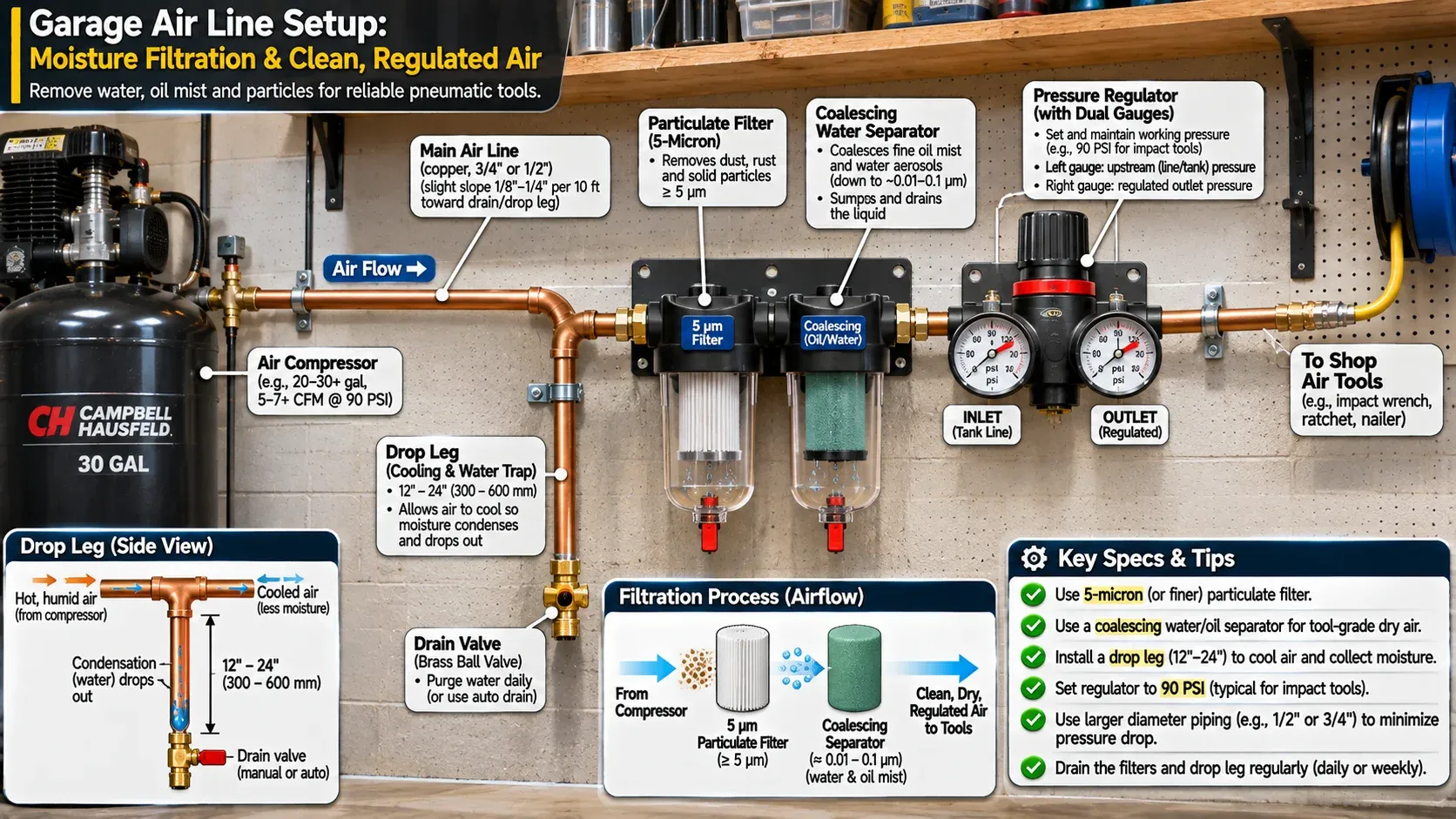
Clean technical schematic of a garage pneumatic air line moisture filtration setup, copper drop leg cooling pipe, 5-micron particulate filter and coalescing water separator trap with brass drain valve, inline pressure regulator with dual gauges, professional workshop layout.
Workshop Compressed Air Diagnostic: Sizing Compressors to Real Tool Demands
Determine the exact CFM volume and tank reserve capacity required for your garage workflow.
Rotating tires, brake jobs, and suspension swaps on family vehicles on weekends
Continuous die grinding, dual-action sanding, sandblasting, or full auto body painting
Bicycle tire inflation, trim brad nailing, and benchtop air dusting
Tank Size vs. Pump CFM: The Balance Equation
When you pull the trigger on an impact wrench to break free five rusted lug nuts on a truck wheel, you need roughly fifteen seconds of uninterrupted, high-velocity airflow. That initial burst of energy comes from the air stored inside your tank, not from the electric pump running in real time.
A small six-gallon tank holds very little buffer volume. After four seconds of continuous hammering, the tank pressure plunges from 120 PSI down to 65 PSI.
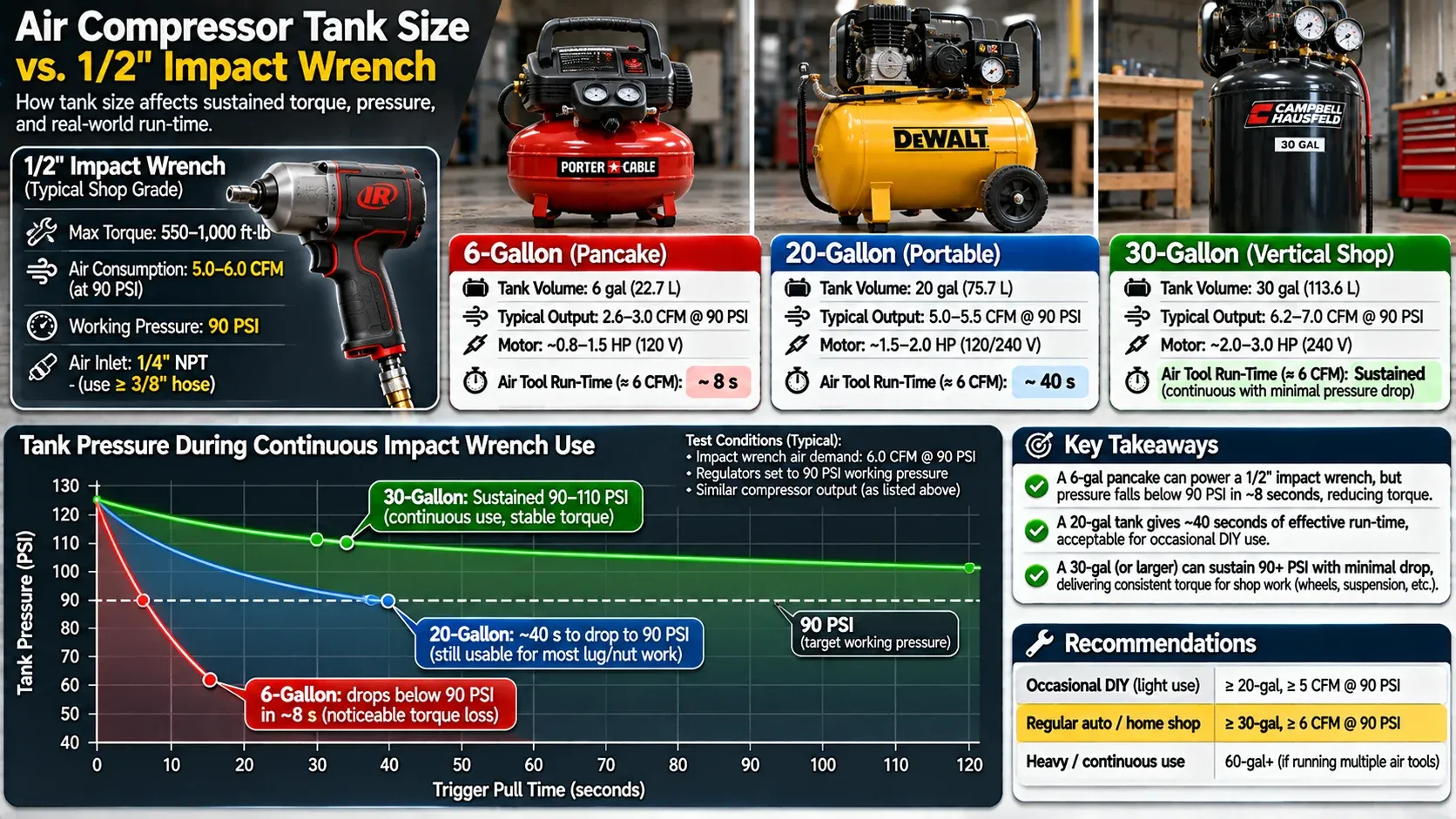
Educational pneumatic infographic chart comparing air compressor tank sizes under 1/2-inch impact wrench demand, showing continuous run-time curves: 6-gallon pancake tank (pressure drops below 90 PSI after 8 seconds of trigger pull) vs 20-gallon portable vs 30-gallon vertical shop compressor (sustained torque delivery), bold modern engineering visuals.
At 65 PSI, your impact gun loses 40 percent of its rated breakaway torque, turning high-speed hammering into weak, useless taps. You find yourself standing around the vehicle waiting two minutes for the little electric pump to recharge the tank before you can attempt the second lug nut.
A ten to twenty-gallon storage tank acts as an energy accumulator. That volume stores enough compressed air to spin off all five lug nuts on a wheel before the tank pressure drops below the tool’s 90-PSI operational threshold, allowing you to complete tire rotations without waiting for pump recovery cycles.
The Hidden Choke Points: Hoses and Couplers
Plumbing your air distribution lines correctly matters just as much as line diameter. Never glue hardware store plastic lines to feed your tools; read why PVC pipe is dangerous for compressed air to understand the shrapnel risk under pressure.
Many DIY mechanics invest five hundred dollars in a quality compressor and an expensive impact gun, only to connect them with a cheap quarter-inch coiled plastic hose and standard hardware store quick-disconnect fittings.
Every reduction in internal diameter acts as an energy restriction that strangles your air tools. A fifty-foot run of quarter-inch air hose causes a catastrophic 20 to 25 PSI pressure drop between the compressor regulator and your tool handle.
You must run a minimum 3/8-inch internal diameter rubber or hybrid polymer hose, such as Flexzilla, to minimize wall friction over distance. Even more critical is replacing the restrictive factory couplers.
Standard 1/4-inch Industrial (Type I/M) couplers feature a tiny internal orifice that chokes airflow. Upgrading your hose ends and tool fittings to Milton V-Style High-Flow couplers increases airflow through the exact same 1/4-inch NPT threads by up to 70 percent, instantly delivering noticeable hammer force to your impact wrench.
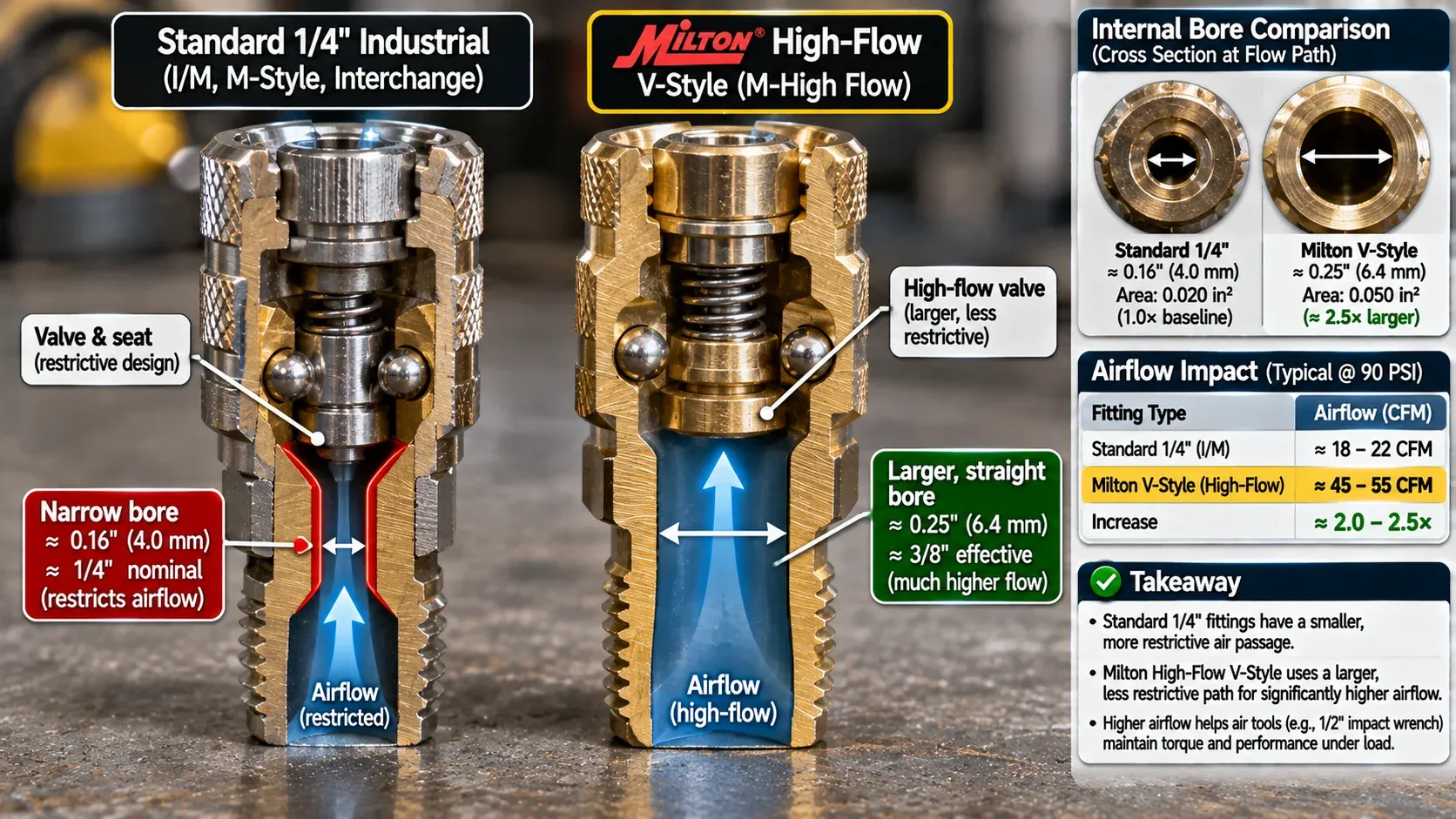
Macro cross section comparison photo of two pneumatic air hose couplers cut in half, left showing standard 1/4-inch industrial fitting with restrictive narrow internal bore reducing airflow, right showing Milton High-Flow V-style fitting with enlarged unobstructed air passage, airflow restriction callout arrows.
Garage Air Compressor Sizing Matrix: Portable vs. Shop Units
Comparing CFM output, decibel noise levels, footprint, and actual automotive capability.
6-Gallon Pancake Compressor
Brad nailers, airbrushing, and bicycle tires
- Lightweight, compact, and extremely portable
- Cannot remove stubborn lug nuts without stalling after two seconds
10 to 20-Gallon Quiet Compressor (California Air Tools)
Weekend automotive maintenance, suspension work, and tire changes
- Powers 1/2-inch impact guns effortlessly on standard 120V household outlets
- Slightly heavier footprint on small rolling rubber wheels
60-Gallon Stationary 240V Cast-Iron Unit
Full restoration shops and metal fabrication businesses
- Runs sanders, paint guns, and die grinders without ever dropping pressure
- Massive physical size requires permanent mounting and a dedicated 240V circuit
The Honest Alternative: Is Cordless Electric Better for You?
As a former equipment mechanic, I love pneumatic tools for their lightweight ergonomics, durability, and invulnerability to rain or motor burnouts. However, you must evaluate your workshop space and budget honestly before investing in an entire pneumatic infrastructure.
If you already own an air compressor for blowing dust, pumping tires, and running nailers, buying a quality pneumatic impact gun like the Ingersoll Rand 2235TiMAX makes complete economic sense for under two hundred dollars.
If you currently own zero air equipment, buying a dedicated 15-gallon compressor, fifty feet of 3/8-inch hybrid hose, Milton high-flow fittings, and an air gun will easily cost five to six hundred dollars.
In that scenario, purchasing a modern 18-volt or 20-volt cordless brushless mid-torque impact wrench from Milwaukee or DeWalt is often the smarter financial move. Modern cordless tools produce over 600 foot-pounds of breakaway torque, slip into a drawer, and require zero hoses, drain valves, or loud pump motors.
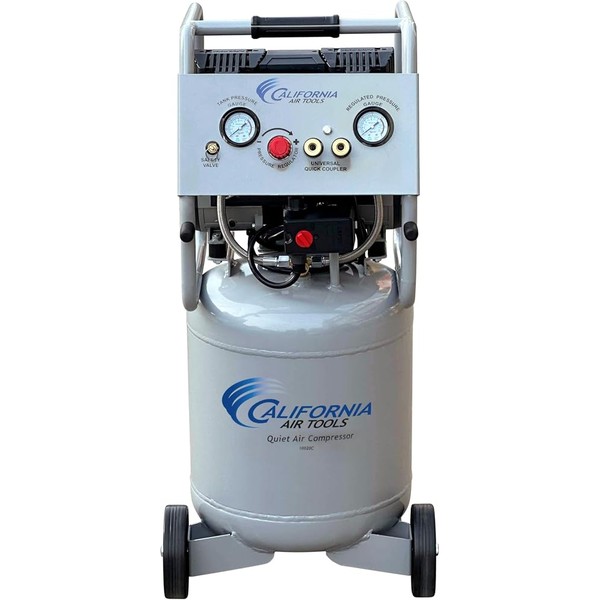
California Air Tools 10020C Ultra-Quiet 10-Gallon Air Compressor
Best For: Running 1/2-inch impact wrenches on 120V garage circuits
Est. Price: $350 - $390
"The ideal residential automotive compressor, delivering professional CFM flow without the deafening screech of cheap jobsite pumps."
- +Delivers 5.3 CFM @ 90 PSI, comfortably powering automotive impact guns
- +Ultra-quiet 70 dB operation allows normal conversation while running
- +Oil-free dual-piston pump requires zero routine fluid changes
- -Horizontal tank footprint requires dedicated floor space under benches
- -Not intended for continuous sandblasting or industrial die grinding
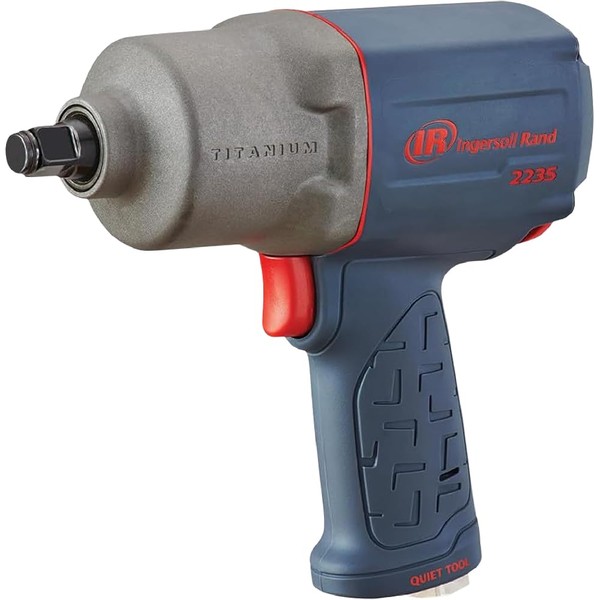
Ingersoll Rand 2235TiMAX 1/2-Inch Drive Air Impact Wrench
Best For: Busting rusted suspension bolts and vehicle lug nuts
Est. Price: $230 - $260
"The undisputed king of automotive pneumatic impact guns, combining featherweight titanium ergonomics with massive breaking torque."
- +Pumps out 1,350 foot-pounds of nut-busting torque from a 4.6-pound tool
- +Titanium hammer case withstands brutal drop impacts onto concrete
- +Twin-hammer mechanism delivers smooth, balanced rotational impact
- -Demands high-flow 3/8-inch air delivery to achieve full rated power
- -Requires daily drops of pneumatic air tool oil in the inlet
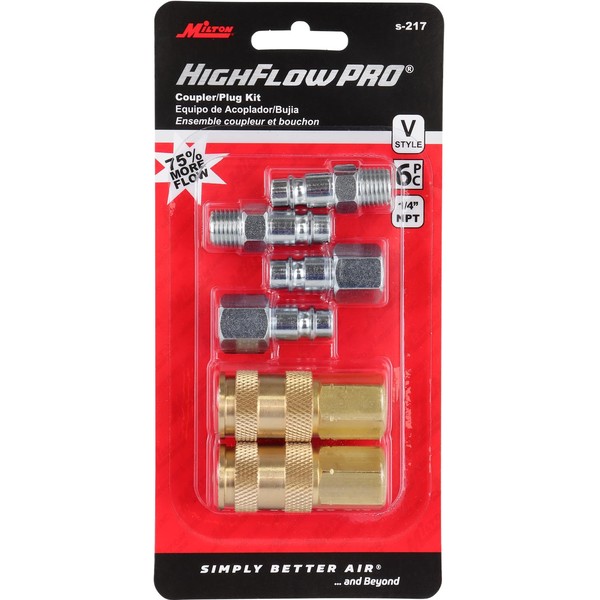
Milton V-Style High-Flow Air Coupler & Plug Kit (1/4-Inch NPT)
Best For: Eliminating airflow choke points at hoses and tools
Est. Price: $14 - $18
"The cheapest and most effective upgrade in pneumatic mechanics, instantly unlocking full torque from your existing impact wrenches."
- +Delivers up to 70 percent more CFM through standard 1/4-inch NPT threads
- +Durable brass and case-hardened steel construction resists shop wear
- +Compatible with standard high-flow automotive tool inlets
- -Will not connect to standard Industrial Type I/M shop couplers
- -Requires converting all hoses and air tools to V-style fittings
Optimizing Your Workshop Compressed Air Lines
Once you select a compressor with adequate CFM output, organize your shop layout to deliver air smoothly across the bay without tripping hazards.
Mount your air delivery lines overhead using spring-loaded retractable reels by checking out our complete setup guide on overhead retractable cord and hose reels.
If you plan to step up to an industrial 240-volt stationary air compressor in the future, ensure your garage electrical system can handle the high inductive motor start load by following our wiring guide on wiring a serious garage workshop subpanel.
Hank Miller
Hank is a master craftsman and DIY mechanic based in Ohio. He tests workshop equipment, garage floor coatings, and power tools under brutal, real-world workshop conditions, with zero paid brand sponsorships.