Clear the Clutter: The Best Overhead Retractable Cord and Air Hose Reels for Home Shops

Tired of tripping over stiff rubber hoses and having creeper wheels jam on tangled yellow extension cords? Here is how to mount power and air overhead.
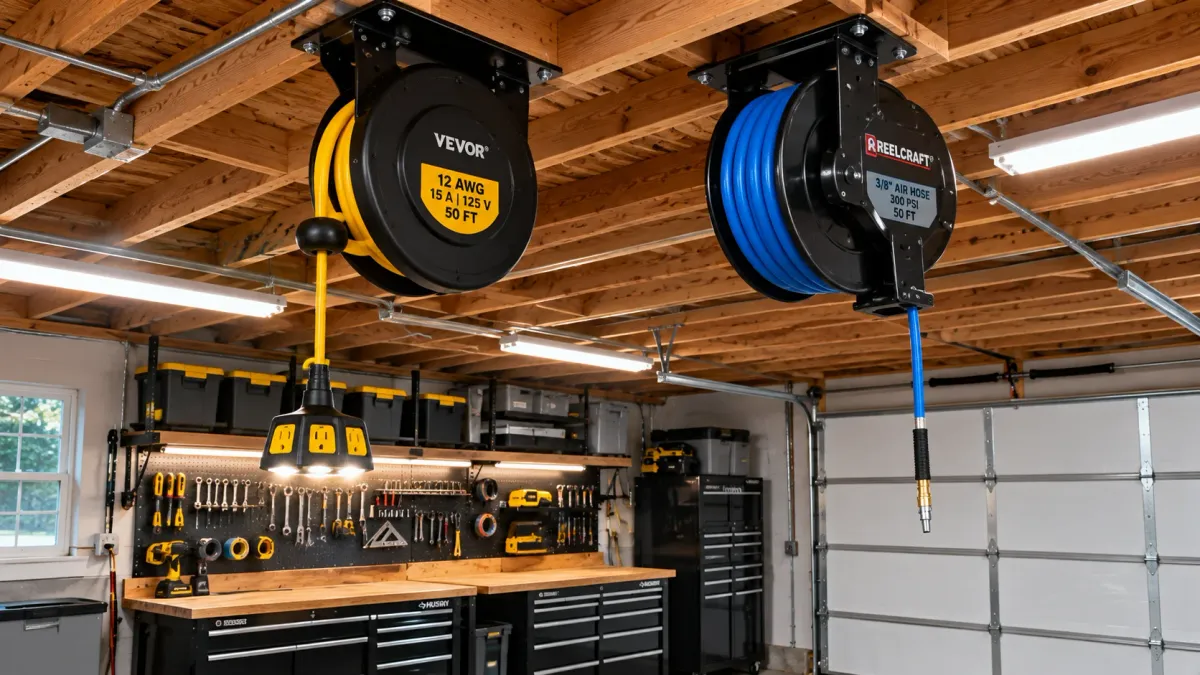
Table of Contents7 Sections
- 01.The Tripping Hazard Underfoot: Why Ground Cords Kill Workshop Flow
- 02.The 12-Gauge Mandate: Why Wire Thickness Is Non-Negotiable
- 03.Top Pick: The Indestructible 12AWG Power Reel
- 04.Air Hose Evolution: Say Goodbye to Stiff Rubber
- 05.Mounting Geometry: The 360-Degree Sweet Spot
- 06.The Bottom Line on Cord and Hose Reels
- 07.Powering and Plumbing Your Overhead Drops
You lie back on a mechanic creeper, push off with your boots to slide beneath an oil pan, and the small swivel caster jams dead against a stiff orange air hose coiled on the floor. You yank the hose in frustration, knock over a drain pan of used oil, and spend the next twenty minutes untangling cables rather than fixing cars.
Shop floors exist for boots, rolling tool carts, and floor jacks; they should never serve as storage mats for extension cords and air lines.
Rolling your truck tires across dropped electrical cords damages internal copper conductors, creating hidden electrical shorts and hot spots. Mounting heavy-duty retractable cord and air reels to your ceiling joists clears floor hazards, speeds up workflow, and delivers power anywhere in your bay within three seconds.
Cord & Hose Reel Specs Compared
Compare electrical wire gauges, hose chemistries, and retraction mechanics.
Light-Duty 14/16-AWG Cord Reel
Basic drop lights and trickle battery chargers only
- Inexpensive
- Light housing mounts easily with one wood screw
- Suffers severe voltage drop under 15A loads
- Trips internal thermal breaker on compressors
Heavy-Duty 12/3 SJTW Cord Reel
Circular saws, 15A angle grinders, and high-draw shop vacuums
- Delivers full 15A continuous current without voltage sag
- Triple lighted tap
- Heavy 15-lb steel housing demands two lag bolts anchored into solid joist wood
3/8-Inch Hybrid Polymer Air Reel
Pneumatic impact wrenches, tire inflators, and blow guns
- Zero memory down to -40°F
- High-flow 3/8-inch internal diameter feeds impact guns
- High-visibility neon green casing shows greasy fingerprints over time
The Tripping Hazard Underfoot: Why Ground Cords Kill Workshop Flow
Under OSHA Standard 1910.305 on electrical cord management and trip prevention, flexible extension cords must not be run across walking paths or exposed to mechanical vehicle pinch hazards.
Leaving power cords draped across concrete causes structural tool damage that most homeowners fail to notice until a tool motor burns out:
- Internal strand fractures: Every time you roll a 4,500-pound SUV tire over an extension cord, vehicle weight crushes individual copper wire strands inside the rubber jacket. Those broken strands reduce conductor cross-section, increasing electrical resistance and heating the cable up.
- Wasted setup time: Uncoiling, plugging in, and manually wrapping a fifty-foot cord consumes ten minutes every project. An overhead retractable reel pulls down in two seconds, latches at your desired length, and retracts smoothly when you tug the line.
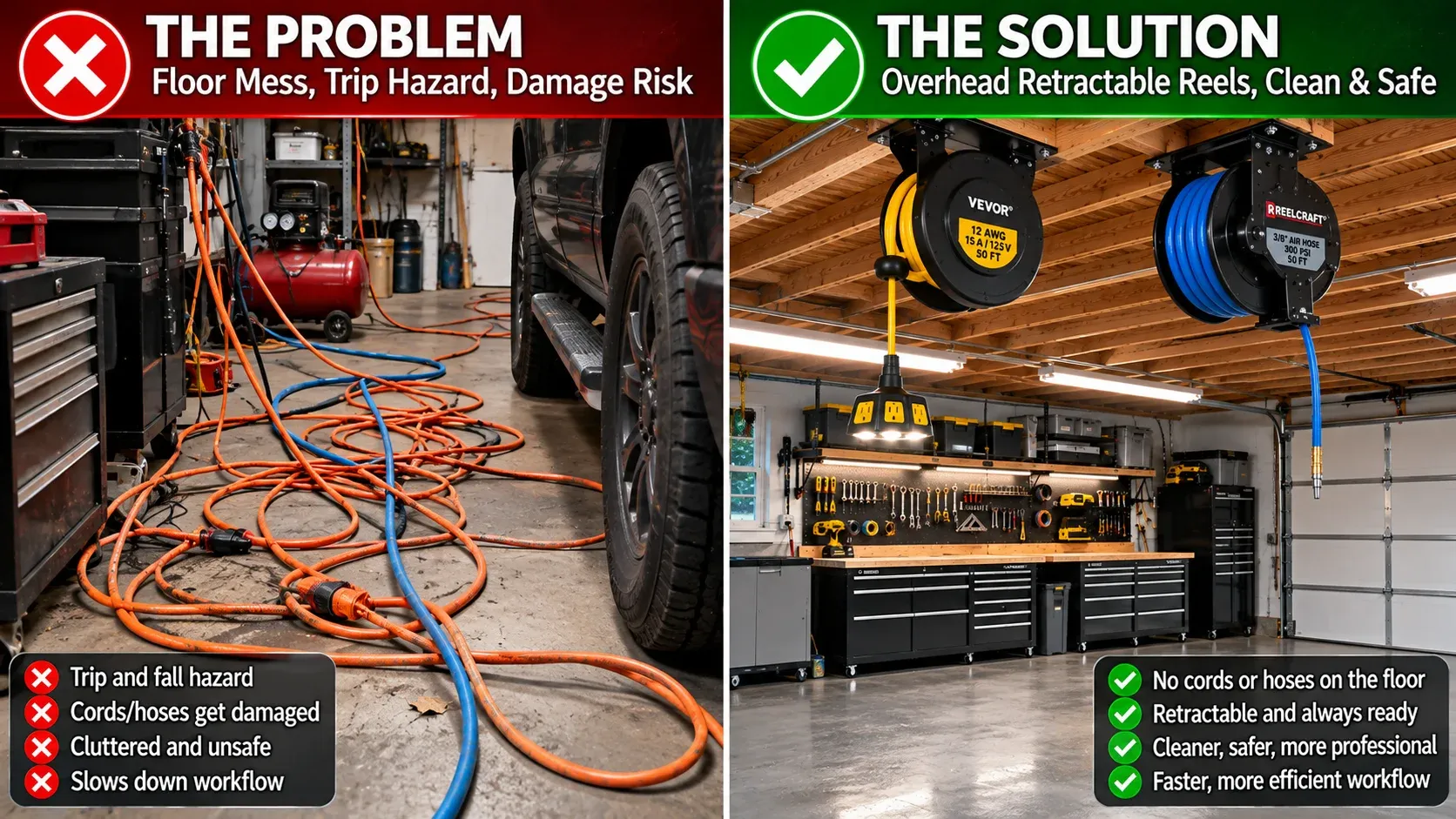
Side-by-side photographic comparison, left side showing dangerous spaghetti mess of orange extension cords and air hoses tangled on garage floor around car tires, right side showing pristine organized shop with overhead retractable reels keeping floor completely clear, crisp graphic styling.
The 12-Gauge Mandate: Why Wire Thickness Is Non-Negotiable
Never hang a cheap 14-gauge or 16-gauge extension cord reel above your workshop.
Running high-draw power tools like 15-amp angle grinders, worm-drive circular saws, or portable table saws through 50 feet of thin 14-AWG copper wire creates significant voltage drop. When line voltage drops from 120 volts down to 108 volts under load, electric motors pull extra amperage to compensate, generating excess internal winding heat that permanently degrades motor armatures.
Insist on an industrial 12/3 SJTW power cord. Thick 12-gauge copper conductors ensure your tools receive full operating voltage without voltage sag or tripping the internal circuit breaker on the reel drum.
Examine the internal slip rings before buying. Quality reels use heavy machined brass contact rings and dual copper-graphite brushes to transfer electrical current as the drum rotates, preventing internal arcing that fries cheaper stamped-metal contacts.
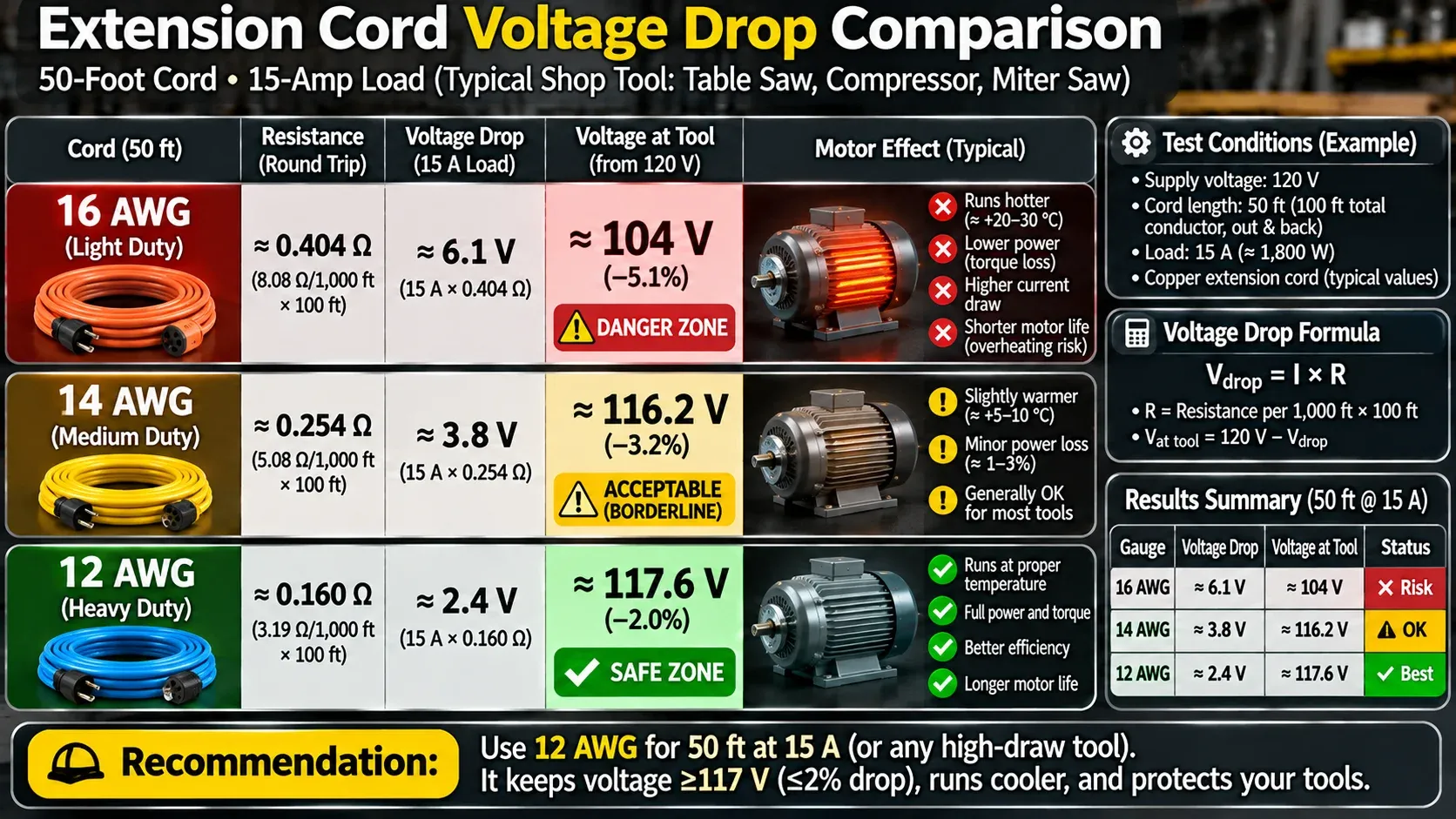
Technical electrical comparison chart showing voltage drop across 50-foot extension cords under 15-amp tool load, comparing 16 AWG (104V danger zone) vs 14 AWG vs heavy-duty 12 AWG (116V safe green zone), motor heat buildup indicators, clean industrial infographic design.
Top Pick: The Indestructible 12AWG Power Reel
For reliable performance in home shops, choose an enclosed polymer or steel reel loaded with 50 feet of heavy 12-gauge cord.
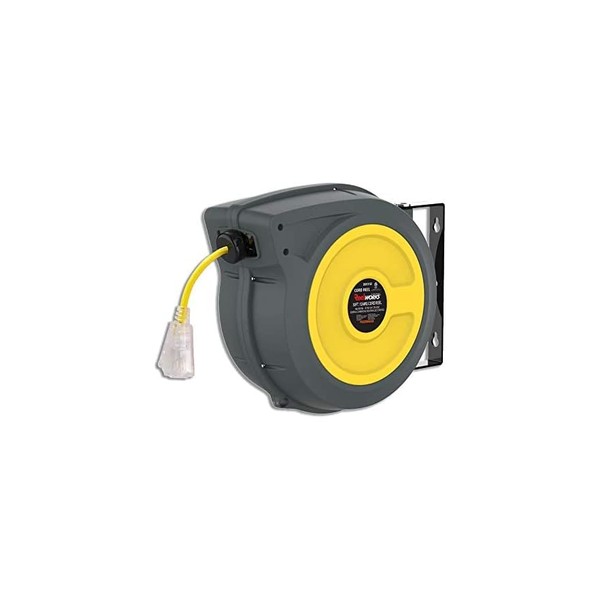
Reelworks 12AWG 50-Foot Retractable Extension Cord Reel
Best For: Supplying full 15-amp electrical power to heavy workshop machinery without voltage drop
Est. Price: $129.99
"The definitive overhead power solution for home garages. It delivers industrial amperage without tripping circuit breakers."
- +Heavy-duty 12/3 SJTW oil-resistant cable safely handles full 15-amp 1,875-watt electrical loads
- +Lighted triple-tap receptacle lets you plug in a shop vac, work light, and charger simultaneously
- +Swivel ceiling mounting bracket rotates 180 degrees to follow tool movement across bays
- -Heavy 14-lb assembly requires solid pilot drilling directly into framing joists
- -Adjustable rubber cord ball stop requires firm clamp screw tightening to prevent slippage
Air Hose Evolution: Say Goodbye to Stiff Rubber
Traditional black rubber and PVC pneumatic hoses turn rock-stiff when garage temperatures drop in November. You fight the coiled memory of the hose, knocking over spray cans while wrestling the line straight.
Modern workshops run hybrid polymer hoses. Hybrid polymer chemistry combines the oil resistance of rubber with the extreme flexibility of lightweight engineered polymers.
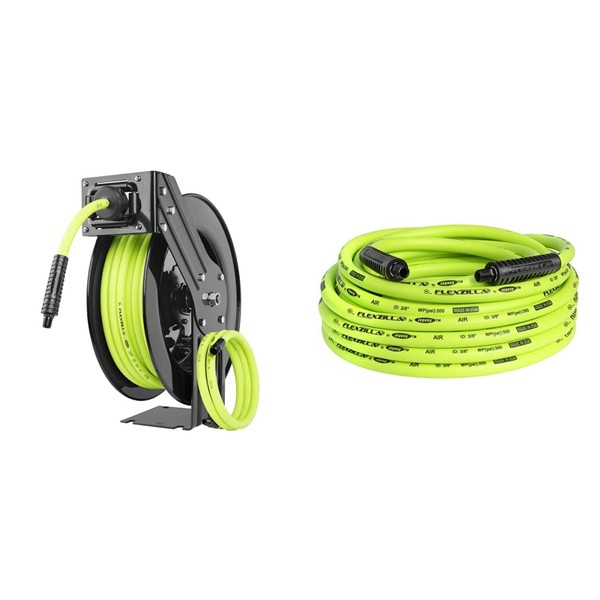
Flexzilla 3/8-Inch x 50-Foot Retractable Air Hose Reel
Best For: Delivering zero-memory high-flow pneumatic air to impact wrenches in freezing shops
Est. Price: $119.99
"The industry standard pneumatic reel. It lays completely flat in sub-zero weather and never coils back up on you."
- +Exclusive hybrid polymer material remains completely flexible down to -40°F
- +High-flow 3/8-inch internal diameter delivers full CFM volume to 1/2-inch impact wrenches
- +Multi-position auto-lock mechanism catches smoothly without erratic ratcheting jams
- -Signature ZillaGreen neon hose jacket attracts oily dirt smears from greasy work boots
- -Includes basic brass couplers that benefit from an upgrade to high-flow steel fittings
The 3/8-inch internal diameter is vital for mechanical work. Cheap 1/4-inch hoses choke CFM airflow, preventing 1/2-inch pneumatic impact wrenches from delivering their full breakaway torque on seized lug nuts.
Mounting Geometry: The 360-Degree Sweet Spot
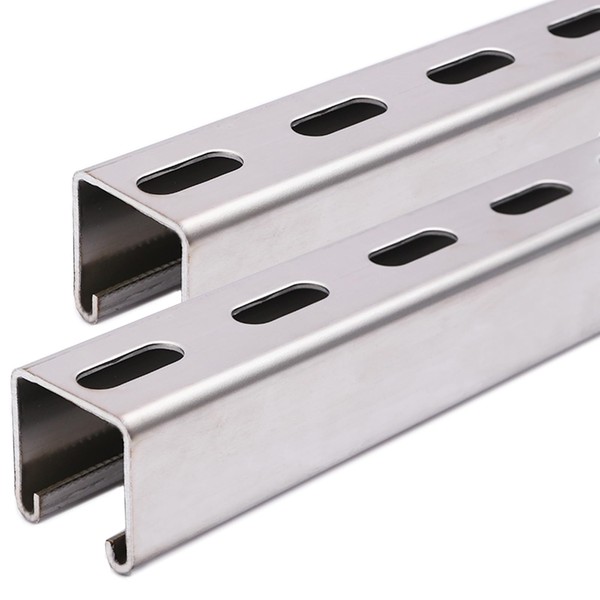
Superstrut 1-5/8-Inch Half-Slot 12-Gauge Steel Strut Channel (10-Ft)
Best For: Bridging multiple ceiling joists to hang heavy power and air reels anywhere
Est. Price: $32.99
"Never hang a 30-pound vibrating hose reel from a single lag screw in drywall; spanning steel strut across two joists creates an indestructible overhead mounting spine."
- +Continuous 12-gauge cold-rolled steel spans across 16-inch or 24-inch ceiling joists
- +Pre-punched slots allow you to position hanging reels exactly between joist bays
- +Supports hundreds of pounds of downward pull without flex or ceiling drywall damage
- -Ten-foot metal channel requires a hacksaw or reciprocating saw to cut to length
- -Requires standard 1/2-inch channel spring nuts and hardware for hanging brackets
Do not mount your cord and hose reels against a distant back corner wall. Mounting in corners forces you to stretch cables around obstacles, shortening their effective reach.
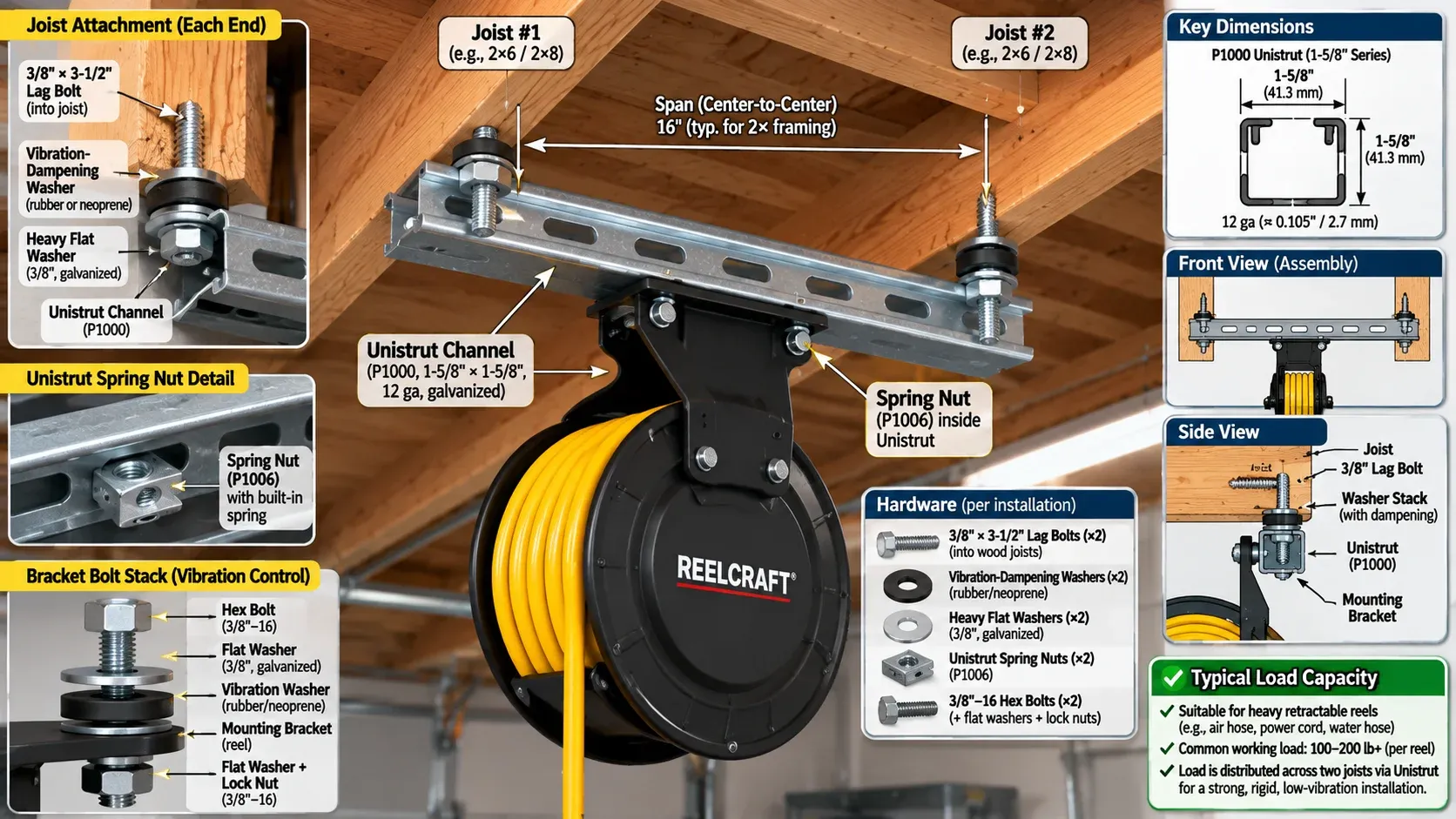
CAD engineering diagram of an overhead retractable reel ceiling installation using a galvanized Unistrut channel spanning across two adjacent wood joists, heavy 3/8 lag bolts into joists, spring nuts securing reel mounting bracket, vibration dampening washers, clear isometric view.
Position your reels on the center ceiling joist between your vehicle parking bays, roughly 4 feet back from the overhead garage door:
- From this central ceiling position, a 50-foot cord reaches the front bumper of Car 1, the rear hatch of Car 2, your main workbench, and pulls ten feet out into the driveway to service a lawn mower.
- Mount the power reel and air hose reel 18 inches apart so their payout angles never cross each other.
- Drive two 5/16x3-inch lag bolts through the mounting bracket directly into the center of a ceiling joist; never hang motorized reels using hollow drywall anchors.
The Bottom Line on Cord and Hose Reels
Tangled cords on a concrete floor represent an avoidable shop hazard that slows down work and damages expensive tools.
Hang a 12-gauge power reel and a 3/8-inch hybrid polymer air reel from your central ceiling joist. You will reclaim floor space, protect your equipment from voltage drops, and finish projects in half the time.
Powering and Plumbing Your Overhead Drops
Mounting utility reels overhead requires adequate ceiling framing and clean electrical supply.
Before tapping your ceiling circuits for high-draw reels, ensure your service panel carries dedicated capacity with our guide on wiring a serious garage workshop subpanel.
To pipe your air reel safely without explosive shattering risks, review our warnings in why PVC pipe is dangerous for compressed air.
And to size your air supply for pneumatic tools, match your compressor CFM with our sizing guide on what size air compressor you need for a 1/2 impact wrench.

Hank Miller
Hank is a master craftsman and DIY mechanic based in Ohio. He tests workshop equipment, garage floor coatings, and power tools under brutal, real-world workshop conditions, with zero paid brand sponsorships.