Heating an Uninsulated Garage: Mini-Split Heat Pump vs. 240V Electric Forced-Air

Staring at frozen tools when winter hits 20 degrees? Here is how to choose between cheap-to-buy 240V electric heat and efficient DIY mini-split heat pumps.
Table of Contents6 Sections
When outdoor temperatures plunge to 20°F across Ohio, grabbing a bare steel combination wrench off the tool cart feels like holding an icicle against your palm. You want a heated workspace to keep projects moving through winter, but choosing between a $250 electric forced-air heater and a $1,300 ductless mini-split heat pump comes down to operational math rather than marketing promises.
Before you spend money on heating equipment, you must seal heat leaks. Throwing heat at an uninsulated garage with drafty door seals is like running your central furnace with the living room windows wide open.
Here is how the numbers pencil out between rapid-recovery 240V forced-air heaters and high-efficiency inverter heat pumps, along with the safety reasons why you should banish unvented propane heaters from your shop forever.
Garage Heating Systems Compared
Compare equipment cost, hourly operating expense, and seasonal versatility.
Unvented Propane / Torpedo Heaters
Open pole barns and outdoor framing projects only
- Pumps out 60,000 BTUs instantly with zero electrical wiring required
- Releases gallons of water vapor that coat cast iron tools in rust
- Carbon monoxide danger
240V Hardwired Electric Forced-Air
DIYers working 4 to 8 hours on Saturday and Sunday afternoons
- Heats 400 sq.ft in 20 minutes
- Zero moisture byproduct
- Ceiling-mounted footprint
- Draws 21 amps at 5,000 watts
- Costs roughly $0.75 to $1.10 per continuous operating hour
Ductless Mini-Split Heat Pump (Inverter)
Woodworkers with fine machinery, daily mechanics, and attached finished garages
- Cuts power consumption by 65%
- Provides air conditioning during humid summers
- Higher initial equipment cost
- Demands vacuum pump pull or pre-charged lines
The First Law of Garage Heat: Stop Heating the Neighborhood
Before you install any heat source, you have to button up air infiltration. If you skip sealing gaps around your garage door frame or ignore garage door insulation and spring balance, half your BTUs leak straight into the driveway within ten minutes.
The single largest heat thief in a residential garage is the overhead door. A standard uninsulated stamped-steel garage door acts as a giant radiator that transfers indoor heat straight out into the yard, carrying an insulation value of less than R-1.5.
Before you mount a heater, spend $65 on an insulation kit. Rigid expanded polystyrene foam inserts slide into the interior ribs of your door panels, raising the thermal barrier to R-8.
Next, inspect the bottom rubber sweep and perimeter vinyl weatherstripping. If you turn off your garage lights at noon and see sunlight glowing around the edges of the overhead door, cold wind drafts into the room and strips heat faster than a 5,000-watt element can produce it.
Pair door sealing with moisture checks. Cold concrete slabs absorb moisture during temperature spikes; review our guide on how to stop garage floor sweating in winter to ensure heating cycles do not trigger condensation puddles.
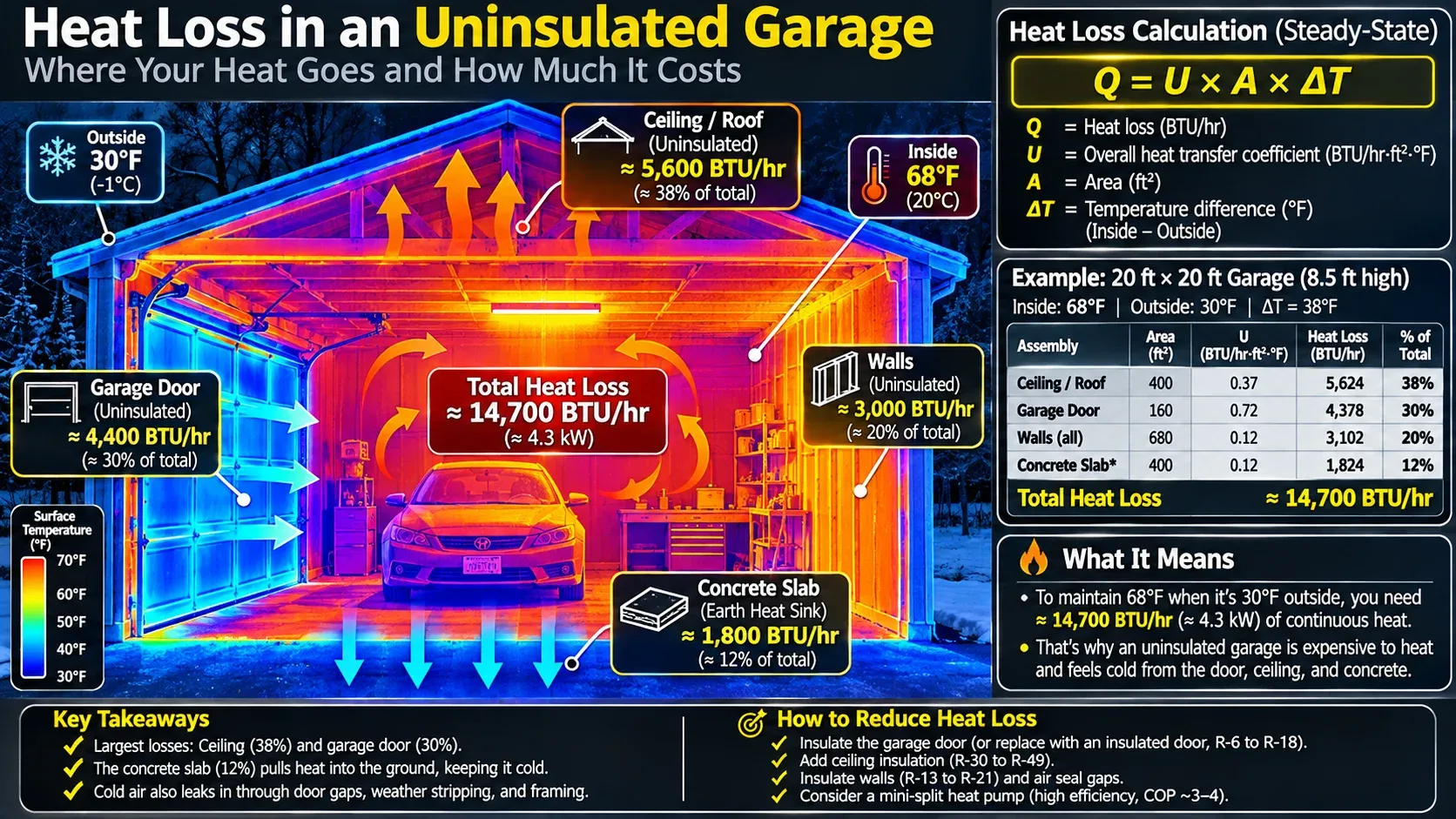
Thermal imaging style cutaway diagram of an uninsulated residential garage showing heat loss vectors, cold air intrusion through uninsulated garage door panels, ceiling escape path, cold concrete slab heat sink, color-coded temperature gradient from blue to red with BTU calculation formula.
Option 1: The 240V Electric Forced-Air Unit
If you only use your workshop on weekends for four to six hours at a stretch, a 240V hardwired electric unit heater represents the smartest equipment investment.
These heaters mount up out of the way on a swivel ceiling bracket, pull cold air across a high-wattage coiled nichrome heating element, and blast warm air down toward your work benches.
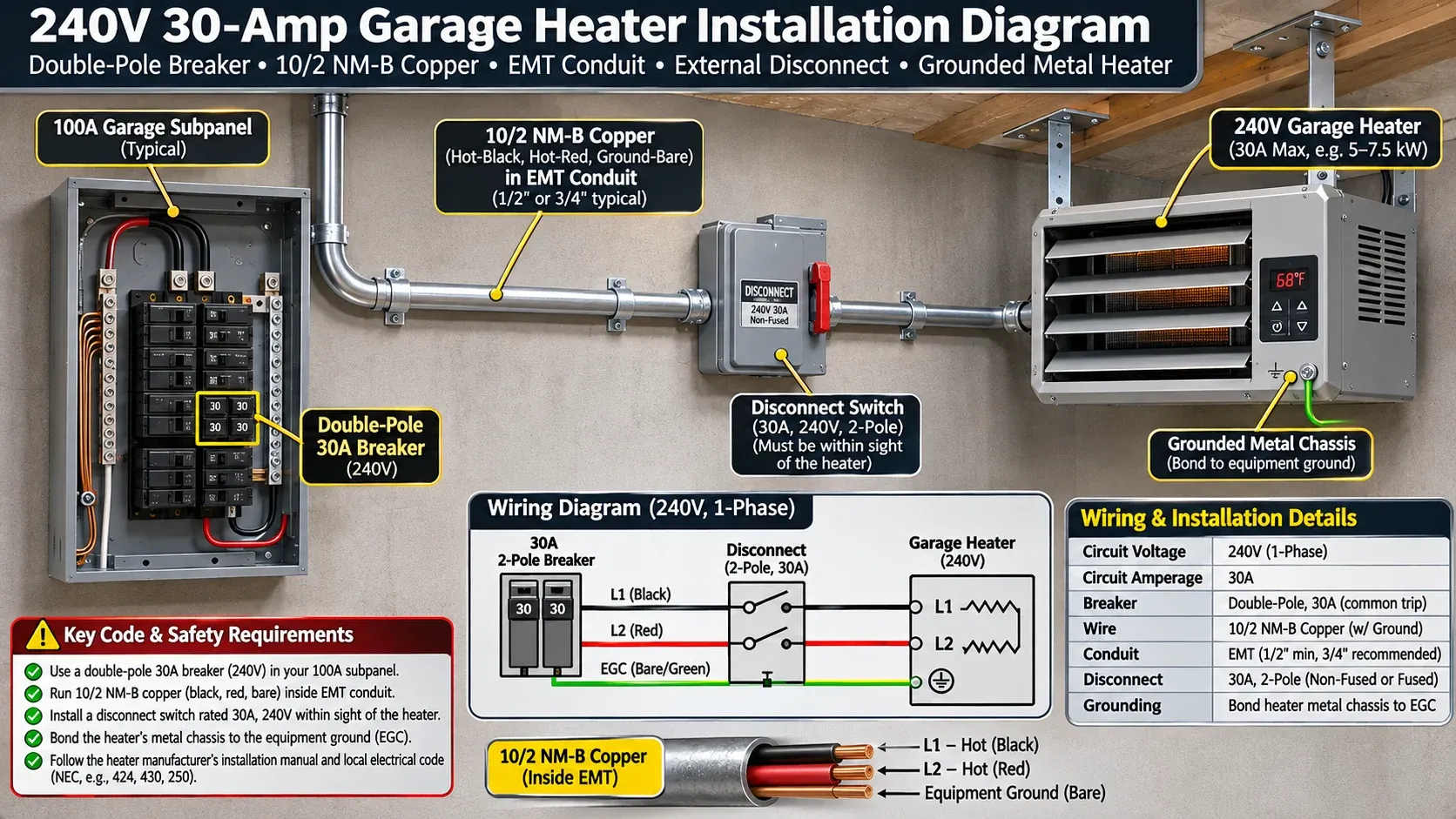
Clear technical electrical diagram for a 240V 30-amp garage heater installation, showing double-pole breaker in 100A subpanel, 10/2 NM-B copper wiring run in EMT conduit, external disconnect switch, grounded metal chassis, professional CAD electrical style.
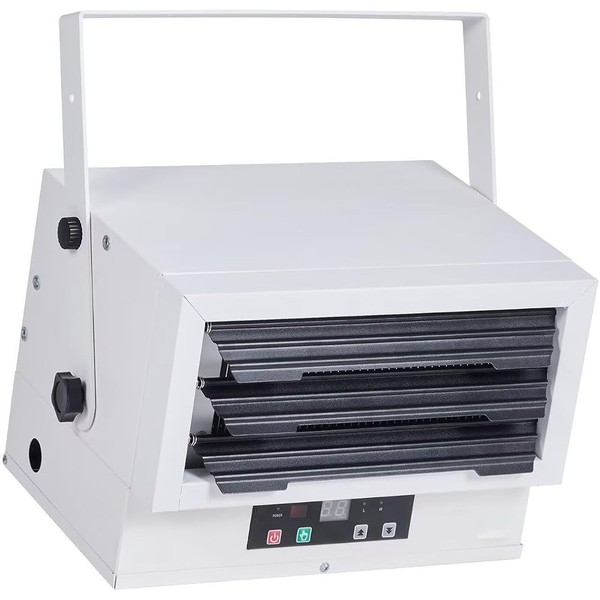
Fahrenheat 5,000-Watt 240V Electric Garage Heater
Best For: Heating a two-car garage quickly for weekend wrenching sessions
Est. Price: $289.99
"The standard reliable heat source for part-time DIYers. It heats your workspace quickly and keeps floor space clear."
- +Pumps out 17,060 BTUs to raise a 400-sq.ft garage from 25°F to 60°F in 30 minutes
- +Ceiling-mount swivel bracket points directional airflow directly at floor level
- +Zero combustion gases, open flames, or moisture byproduct to protect metal tools
- -Requires a dedicated 240V 30-amp circuit wired with 10-AWG copper wire
- -Draws substantial electrical power when running continuously during bitter cold snaps
To run this unit safely, you must wire a dedicated 240-volt 30-amp double-pole breaker from your electrical panel using 10/2 with ground copper Romex. Standard 120-volt household plug-in space heaters produce barely 5,100 BTUs at 1,500 watts, which proves completely inadequate for a cold two-car garage.
Calculate operating expense simply: A 5,000-watt heater running continuously uses 5 kilowatt-hours per hour. At an average national residential rate of $0.16 per kWh, heating your shop costs roughly $0.80 per hour. For a four-hour Saturday maintenance chore, you spend around $3.20 in electricity.
Option 2: The Ductless Mini-Split Heat Pump
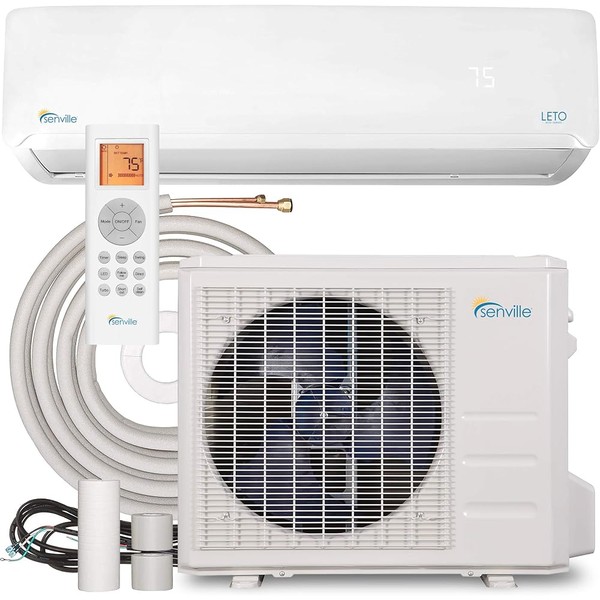
Senville LETO 18,000 BTU Ductless Mini-Split Heat Pump (20.8 SEER2, 230V)
Best For: Year-round climate control (heating & cooling) in insulated two-car garages
Est. Price: $899.00
"If you spend 20+ hours a week in your shop year-round, the energy savings and summer cooling make a mini-split pay for itself in three seasons."
- +Delivers 3.0+ COP heating efficiency down to 5°F outdoor ambient temperatures
- +Cuts winter operating electric costs by 60% compared to resistive element heaters
- +Doubles as an ultra-quiet summer air conditioner and shop dehumidifier
- -Higher upfront equipment and installation cost than basic resistive heaters
- -Demands vacuum pump line evacuation or HVAC professional flaring tools
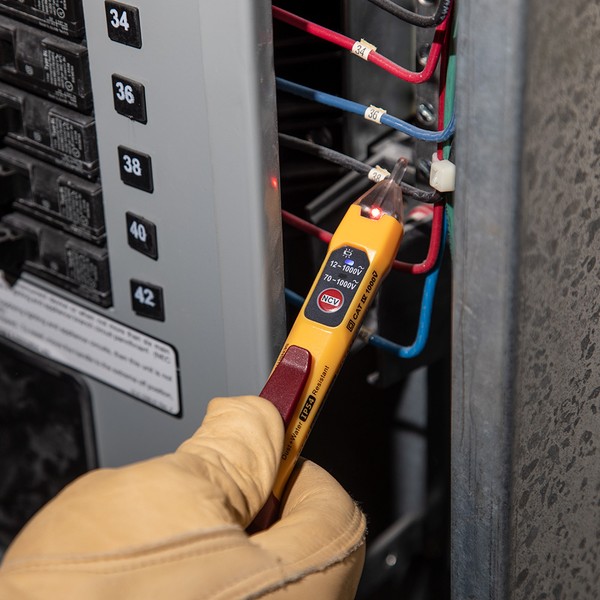
Klein Tools NCVT-2P Dual-Range Non-Contact Voltage Tester
Best For: Verifying 120V and 240V lines are dead before opening electrical disconnects
Est. Price: $19.97
"Never touch 240V heater terminals or mini-split disconnect wires without verifying zero voltage; this Klein tester is your primary life insurance policy."
- +Dual-range sensing detects standard 70-1000V AC and low-voltage 12-48V AC controls
- +Bright green/red LED indicators and loud audible buzzer confirm live conductors
- +Integrated bright flashlight illuminates dark electrical junction boxes
- -Sensitive to nearby electrostatic static charges if touched against carpet or plastic
- -Requires 2 AAA batteries that should be tested before every electrical check
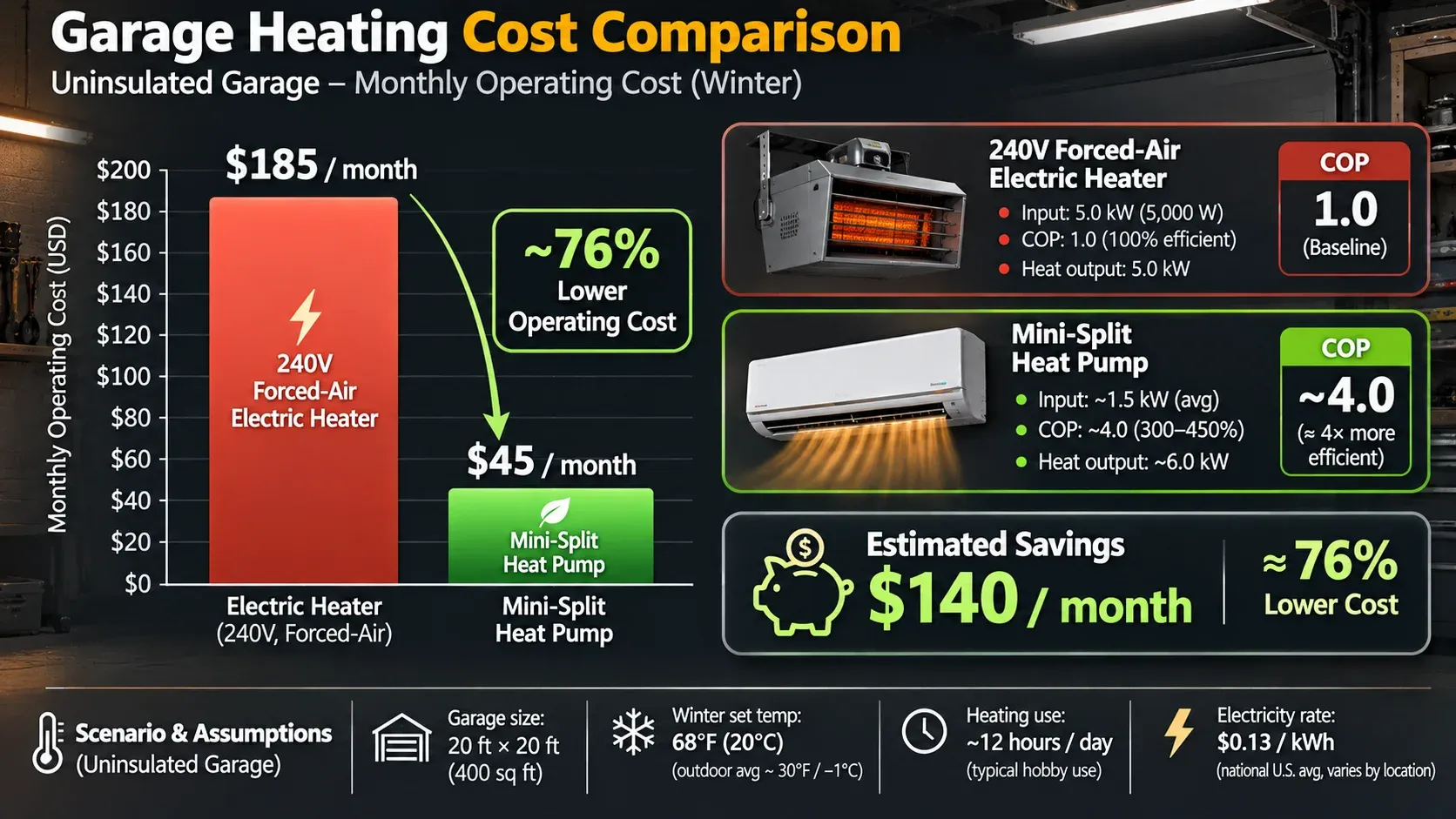
Comparative financial infographic chart comparing monthly heating operating costs in an uninsulated garage, bar graph showing 240V forced-air electric heater at $185 per month vs mini-split heat pump at $45 per month, COP efficiency comparison callouts, clean dark-mode typography.
Modern cold-climate ductless mini-splits certified under Energy Star heat pump efficiency guidelines deliver coefficient of performance ratings above 3.0 even when outdoor temperatures plunge into the teens.
If you spend twenty hours a week in your workshop building furniture, reloading ammunition, or restoring classic cars, a ductless mini-split heat pump delivers massive long-term savings.
Electric resistance heaters convert one watt of electricity into exactly one watt of heat, producing a Coefficient of Performance (COP) of 1.0. Heat pumps do not create heat through resistance coils; they use an inverter-driven compressor and refrigerant lines to extract latent ambient heat from outdoor air and pump it indoors.
Modern cold-climate heat pumps deliver a COP between 2.5 and 3.5. For every single watt of electrical power consumed, the mini-split delivers up to three and a half watts of heat into your garage, slashing your operating electric bill by 60% compared to unit heaters.
- Look for Hyper-Heat ratings: Standard home mini-splits lose efficiency when outdoor air drops below 35°F. Cold-climate inverter units maintain 100% heating capacity down to 5°F and continue pumping heat down to -13°F.
- Maintain a 50°F setback temperature: Do not shut a mini-split off completely during freezing weather. Keeping the garage dialed to a steady 50°F prevents the concrete slab from freezing. Maintaining that baseline consumes minimal electricity and allows the unit to ramp up to 65°F in fifteen minutes when you walk out to work.
- Summer air conditioning bonus: When July humidity arrives, the mini-split acts as a dehumidifier and central AC unit, preventing cast iron table saws from developing flash rust.
Safety Warning: Why Unvented Propane Heaters Are Shop Poison
Hardware stores sell portable unvented propane “torpedo” or sunflower tank-top heaters for around $120. They warm a garage fast, but using them inside an enclosed workshop destroys tools and threatens health.
The chemical combustion of propane yields two direct byproducts: carbon dioxide and water vapor. Burning one gallon of propane pumps roughly one gallon of liquid water directly into your shop air as vapor.
Within twenty minutes of running an unvented propane heater, moisture condenses onto cold steel. Your drill press columns, table saw cast iron wings, and hand plane soles will develop a layer of orange rust before your project finishes. Furthermore, running unvented open flames in an enclosed space without dedicated fresh-air intake draws down oxygen levels and creates lethal carbon monoxide risks.
3 Costly Mistakes When Heating a Workshop
Avoid these heating traps:
- Plugging 120V space heaters into extension cords: 1,500-watt heaters pull 12.5 amps continuously, overheating lightweight 16-gauge cords, melting plastic plugs, and creating fire hazards while failing to warm the room.
- Directing 240V heater airflow straight at windows: Aiming hot air directly at glass panes or thin door panels accelerates thermal loss through the exterior wall. Angle ceiling brackets toward the interior center floor.
- Neglecting sawdust filters on mini-split wall heads: Woodworking dust coats mini-split blower wheels and evaporator fins, choking airflow and halving heat output. Clean nylon intake filters weekly if you generate sawdust.
The Bottom Line on Garage Heat
If you wrench on vehicles four to six hours over the weekend, install a 5,000-watt 240V ceiling-mounted electric forced-air unit. You will spend under $300, keep floor space open, and heat your bay comfortably without high upfront equipment costs.
If you spend regular weekday evenings in your shop or keep expensive woodworking machinery on hand, invest in a 12,000 to 18,000 BTU DIY mini-split heat pump. You will cut winter electric consumption in half and gain full air conditioning during the summer heat.

Hank Miller
Hank is a master craftsman and DIY mechanic based in Ohio. He tests workshop equipment, garage floor coatings, and power tools under brutal, real-world workshop conditions, with zero paid brand sponsorships.