How to Keep Tools From Rusting in a Garage Toolbox (Why Silica Gel Fails & What Actually Works)

Tossing silica packets into an unsealed metal chest fails during spring humidity swings. Learn how VCI vapor capsules, GoldenRod heat, and dry-wax coatings stop rust.
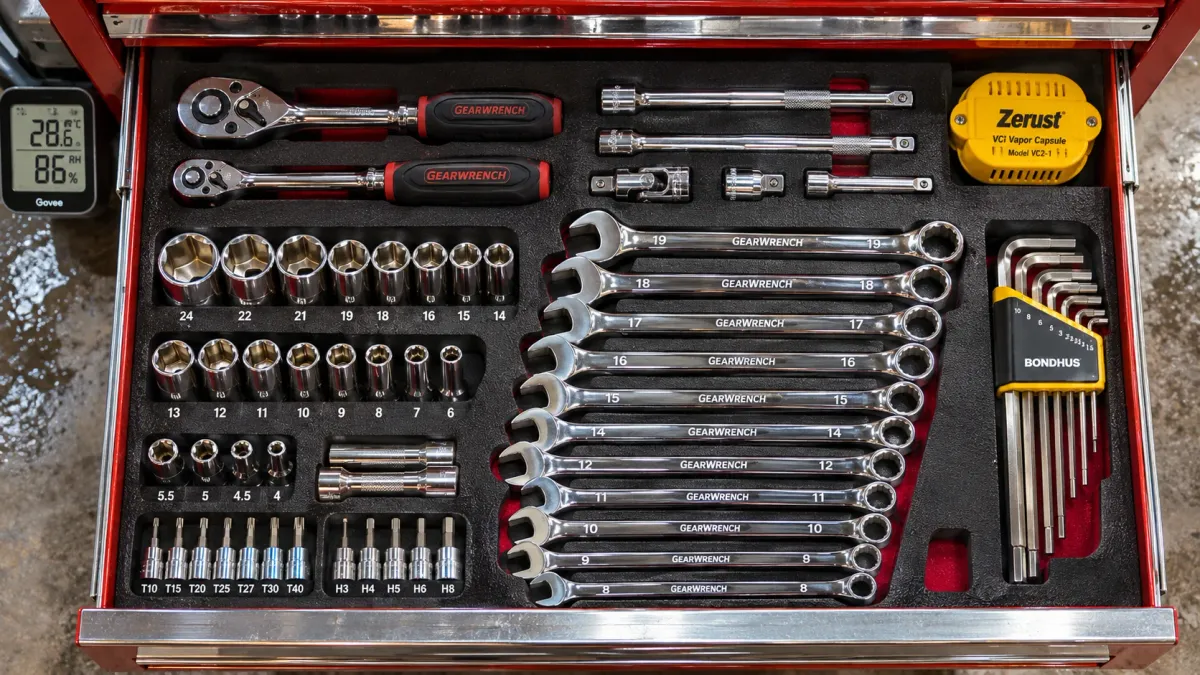
Table of Contents6 Sections
- 01.The Physics of Toolbox Sweat: The Cold Steel Trap
- 02.The 2 False Solutions That Waste Your Time
- 03.Solution 1: The Magic of VCI (Vapor Corrosion Inhibitors)
- 04.Solution 2: The GoldenRod Dehumidifier (For Large Tool Cabinets)
- 05.Solution 3: Boeshield T-9 Dry-Wax Coating for Hand Tools
- 06.Building a Moisture-Resistant Workshop Environment
You walk into your garage after three days of humid spring rain, slide open the top drawer of your steel tool chest, and stop dead in your tracks. Your chrome socket set is speckled with fine orange rust blooms, your precision locking pliers are locked solid at the pivot joint, and your favorite combination wrenches feel coated in a clammy film of water.
Homeowners respond by throwing handfuls of little white silica gel packets into their drawers, or by spraying everything down with standard multi-use penetrant oil. A month later, their chrome tools show even more pitting, and the tools are coated in a foul, greasy sludge that attracts sawdust and slips dangerously out of their hands while wrenching.
I spent twenty years maintaining precision fleet tooling and field service boxes through brutal Midwest freeze-thaw cycles. In this guide, I break down the dew point physics of toolbox condensation, expose why silica gel fails in unsealed cabinets, and show you the three professional anti-corrosion methods that keep steel shiny and dry.
The Physics of Toolbox Sweat: The Cold Steel Trap
Laboratory testing following ASTM B117 standard practice for operating salt spray and corrosion testing demonstrates that unprotected ferrous steel oxidizes rapidly when exposed to cyclic temperature swings in unconditioned air.
Corrosion inside an unheated garage toolbox is rarely caused by water leaking through the ceiling; it is caused by atmospheric condensation driven by thermal inertia.
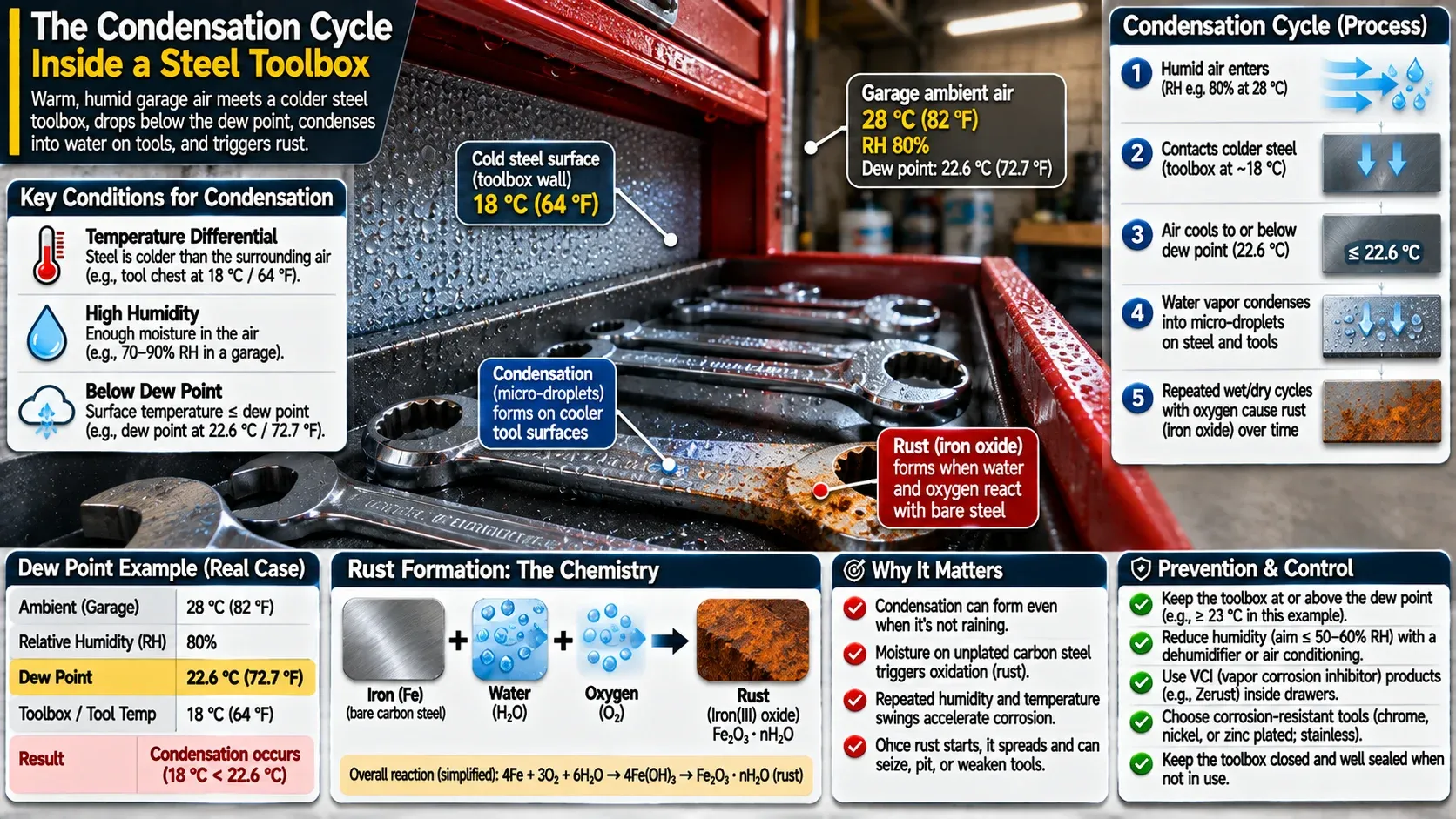
Technical scientific diagram of condensation cycle inside a cold steel toolbox, temperature differential between ambient humid garage air and cold tool chest steel causing micro-droplet moisture formation on unplated carbon steel tool surfaces, red rust oxidation reaction callouts.
Large steel tool chests and heavy chrome-vanadium tools possess immense thermal mass. During a freezing winter night, your 400-pound cabinet, heavy sockets, and steel hammers drop down to thirty degrees Fahrenheit.
When a warm, moist weather front rolls through the following morning, the ambient air temperature inside your garage climbs rapidly to fifty-five degrees with 85 percent relative humidity. Because dense steel warms up far slower than ambient air, your cold tools act like a cold can of soda on a hot summer afternoon.
Moist air slips past drawer gaps, contacts the cold steel, and drops below the dew point, condensing into microscopic water droplets across every bare metal surface. That trapped condensation reacts with oxygen and steel, triggering aggressive surface oxidation within forty-eight hours.
The 2 False Solutions That Waste Your Time
Before implementing real corrosion defenses, you must eliminate two widespread workshop myths that fail to protect metal tools.
Myth 1: Silica Gel Desiccant Packs
Throwing shoe-box silica packets into a rolling tool chest is an exercise in futility. Silica gel functions solely as a passive desiccant inside hermetically sealed containers equipped with airtight rubber gaskets, such as waterproof Pelican cases.
A rolling tool chest is riddled with air gaps around drawer slides, body seams, and rear cable access cutouts. In an unheated garage, loose silica gel packs absorb their maximum capacity of atmospheric water within forty-eight hours, transforming into wet chemical sponges that hold moisture inside your drawers.
Myth 2: Wet Multi-Use Oil Sprays
Coating your hand tools with standard oily penetrants or mineral oils seems logical for displacing water, but wet films create messy shop hazards.
Wet petroleum oil remains sticky, turning your tool drawers into dust magnets that trap fine wood dust, abrasive metal grindings, and floor dirt. When you grab an oily wrench to break loose an oil pan bolt, the greasy film reduces hand grip, strips fastener heads, and rubs off on your clothes and interior vehicle upholstery.
Toolbox Corrosion Diagnostic: Selecting the Right Defense for Your Setup
Match your tool cabinet size, power availability, and tool types to the correct rust-prevention method.
Standard 4 to 8-drawer mobile tool cart without internal 120V power
Large 42 to 72-inch master cabinet with integrated 120V power strip
Cast-iron table saw tops, hand planes, and tools hung on open pegboards
Solution 1: The Magic of VCI (Vapor Corrosion Inhibitors)
If you already have cast iron machinery surfaces with surface oxidation from past winter dampness, follow my step-by-step restoration process on restoring a rusted cast iron table saw top to bring the bare metal back to a mirror finish.
The simplest and most cost-effective rust-prevention upgrade for standard tool drawers is Vapor Corrosion Inhibitor (VCI) technology.
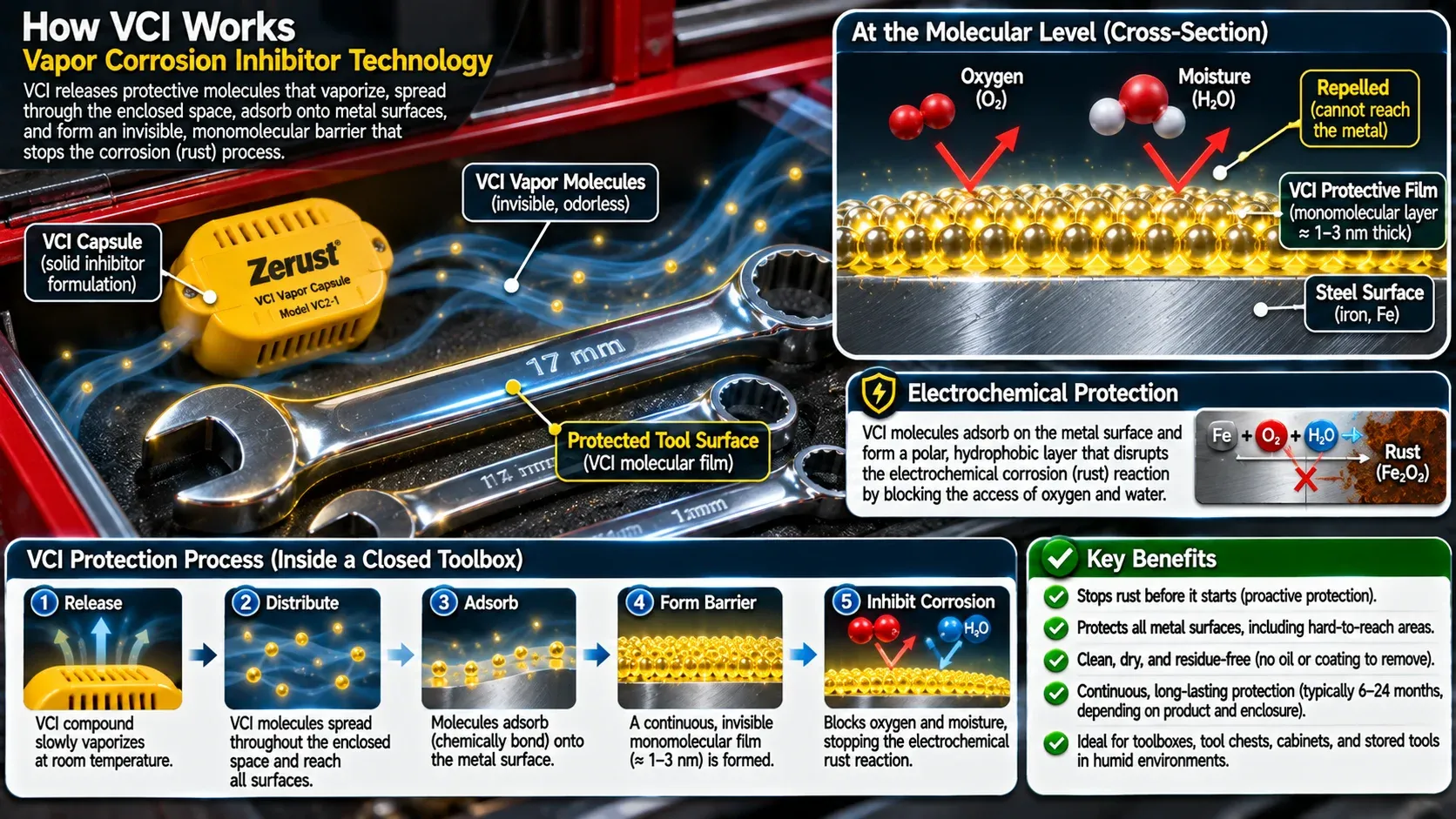
3D scientific microscopic diagram explaining VCI (Vapor Corrosion Inhibitor) technology, vapor molecules evaporating from capsule and forming an invisible monomolecular protective electrochemical barrier over steel wrench surface, repelling oxygen and moisture molecules, futuristic clean graphic style.
Originally developed for military equipment preservation and trans-oceanic machinery shipping, VCI compounds emit an invisible, odorless vapor that permeates enclosed drawer volumes. The polarized vapor molecules actively seek out bare ferrous and non-ferrous metals, bonding to the steel in an invisible monomolecular shield.
This microscopic barrier prevents electrochemical reactions between oxygen, water molecules, and iron atoms. VCI capsules, such as those made by Zerust, peel and stick to the inside wall of each tool drawer, emitting protective shielding that guards two to four cubic feet of enclosed space for up to two years without leaving oily residue.
Solution 2: The GoldenRod Dehumidifier (For Large Tool Cabinets)
If you own a heavy 40-inch to 72-inch professional roll cab from brands like US General, Milwaukee, or Snap-on, the ultimate anti-corrosion defense is proactive thermal management.
The GoldenRod is a solid-state low-wattage electric heating tube originally engineered to eliminate moisture inside gun safes. Mounted horizontally at the very bottom of your tool chest carcass, the 12-watt heating element warms the air inside the cabinet by three to five degrees Fahrenheit above ambient garage air.
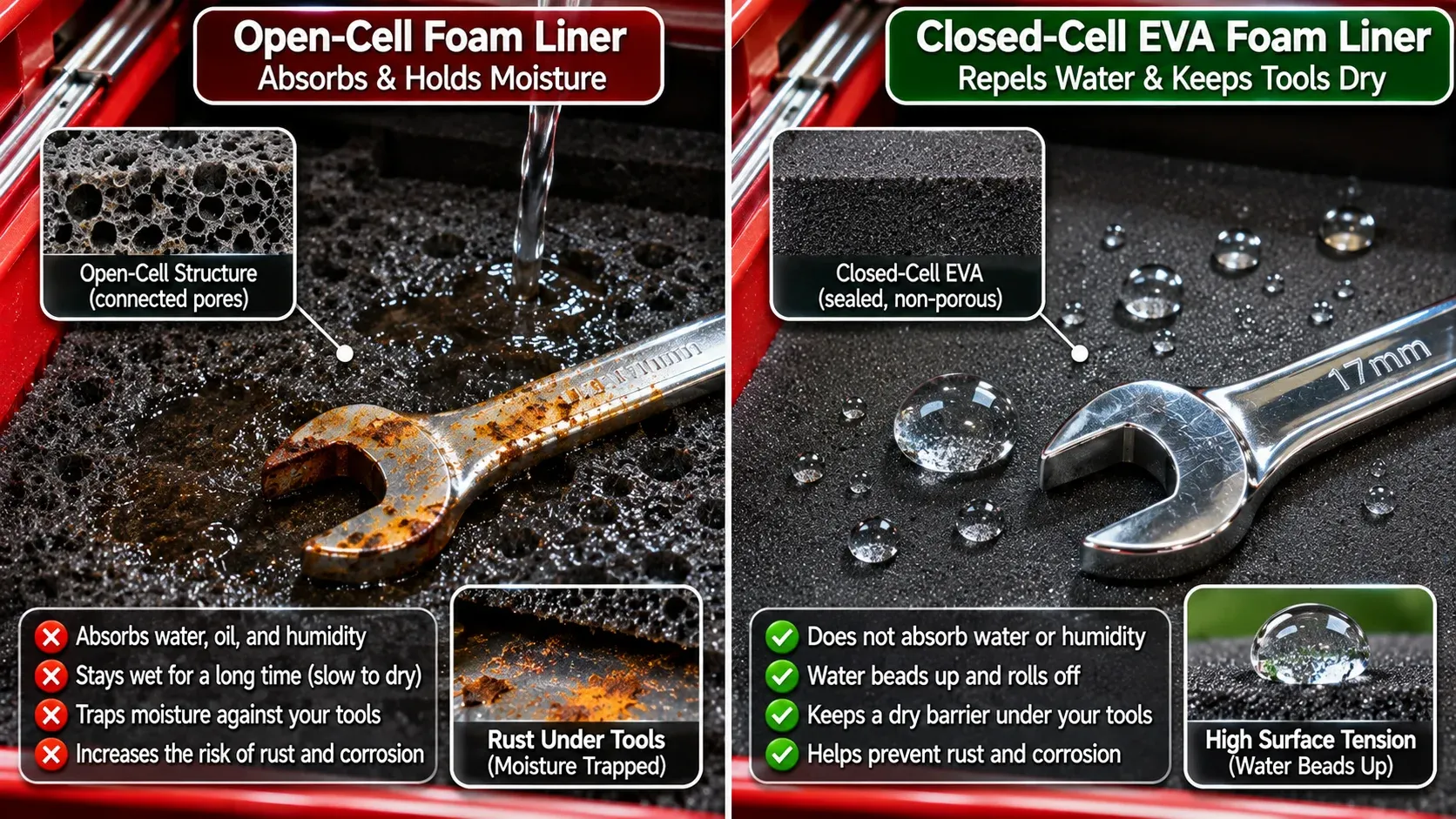
Water droplet behavior on toolbox drawer liners, left side open-cell foam absorbing water like a sponge causing rust underneath tools, right side dense closed-cell EVA foam repelling water droplets with high surface tension bead-up, sharp clear detail.
By maintaining the steel cabinet and tools slightly above the surrounding air temperature, you eliminate the physical conditions required for condensation. Relative humidity inside the cabinet drops automatically, completely preventing moisture from sweating onto cold steel sockets.
Solution 3: Boeshield T-9 Dry-Wax Coating for Hand Tools
For hand tools stored on open wall racks, or cast-iron machinery surfaces like table saw tops and jointer beds where VCI vapors cannot be contained, use a specialized dry-film wax protectant.
Boeing Aviation engineers formulated Boeshield T-9 specifically to penetrate fastener seams and provide long-term corrosion resistance on commercial aircraft components. You spray T-9 onto clean metal, allow the solvent carrier to penetrate microscopic pores for fifteen minutes, and wipe off the excess.
Within two hours, the solvent evaporates, leaving behind an ultra-thin, dry, paraffin-based wax barrier. Unlike motor oil or silicone sprays, cured T-9 is completely non-tacky, resists water wash-off, will not attract sawdust or grit, and keeps bare steel pristine through months of humid weather.
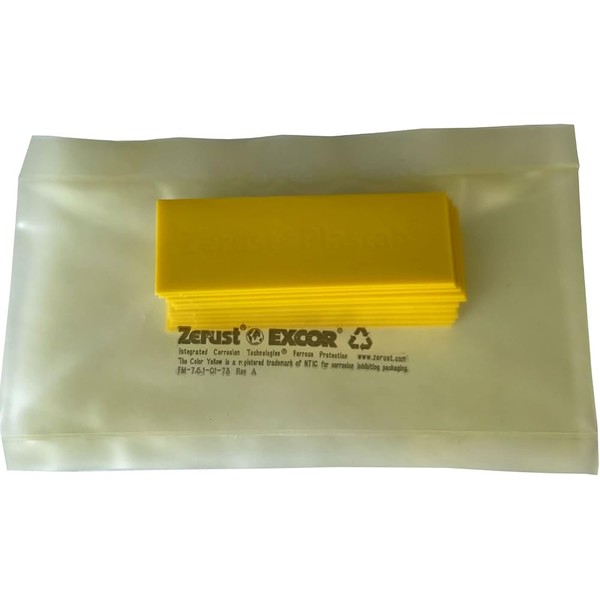
Zerust VC2-2 Vapor Capsules (4-Pack)
Best For: Individual tool chest drawers and tackle boxes
Est. Price: $18 - $24
"The cleanest, most foolproof passive rust defense for rolling toolboxes, completely ending surface pitting on chrome sockets."
- +Emits non-toxic, invisible VCI molecular vapor that shields steel from rust
- +Peel-and-stick adhesive back mounts cleanly to drawer side walls
- +Each individual capsule protects up to 2.2 cubic feet for two full years
- -Only works inside enclosed drawers; ineffective on open shelves
- -Requires replacement every twenty-four months to maintain full vapor density
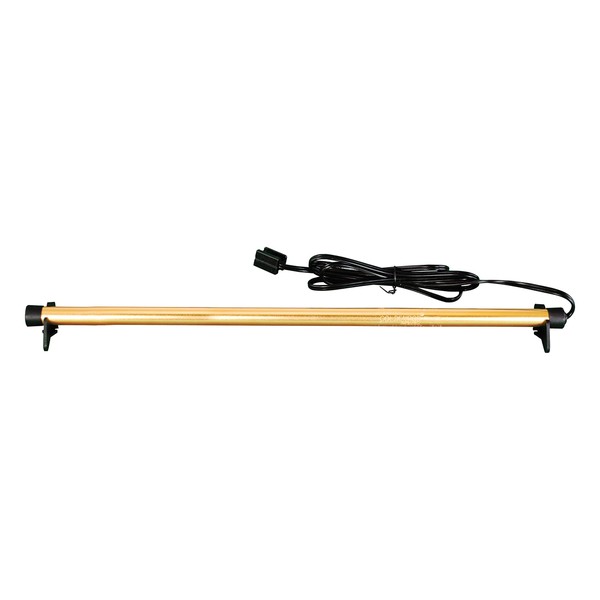
GoldenRod 12-Inch Dehumidifier Heating Rod (12W)
Best For: Large multi-drawer master tool chests with 120V power
Est. Price: $38 - $48
"The definitive engineering solution for eliminating condensation in large, heavy tool chests during spring humidity swings."
- +Continuous convection heating keeps steel tools above the ambient dew point
- +Ultra-low 12-watt power draw costs pennies per month to run continuously
- +Solid-state design with lifetime warranty and no moving parts to fail
- -Requires routing a power cord into the bottom of the tool cabinet
- -Needs careful clearance away from sensitive plastic spray cans
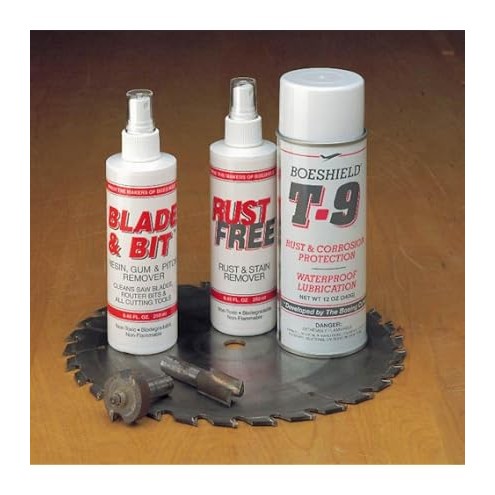
Boeshield T-9 Waterproof Rust Protection Spray (12 oz)
Best For: Open hand tools, pliers, and cast-iron table tops
Est. Price: $19 - $24
"The finest dry-film corrosion barrier available, engineered by Boeing to protect steel without leaving greasy oil slicks on your hands."
- +Dries to a clean, non-tacky paraffin wax film that will not attract sawdust
- +Displaces moisture and lubricates moving pivot joints deeply
- +One single application protects bare steel for up to six months
- -Requires two hours of drying time to achieve full wax cure
- -Thick build-up must be polished lightly with a rag on precision tool faces
Building a Moisture-Resistant Workshop Environment
Eliminating condensation inside your tool drawers is one component of maintaining a healthy, rust-free garage workshop.
If your concrete floor also sweats droplets of water during the same spring warmups, examine the root cause with our diagnostic guide on how to stop garage floor sweating in winter.
If you are planning to add permanent climate control to stabilize your workshop’s ambient humidity and temperature year-round, review our complete heating analysis on heating an uninsulated garage with mini-splits vs. 240V electric.
Hank Miller
Hank is a master craftsman and DIY mechanic based in Ohio. He tests workshop equipment, garage floor coatings, and power tools under brutal, real-world workshop conditions, with zero paid brand sponsorships.